Mainland listing rules under the spotlight
Updated: 2008-01-17 09:29

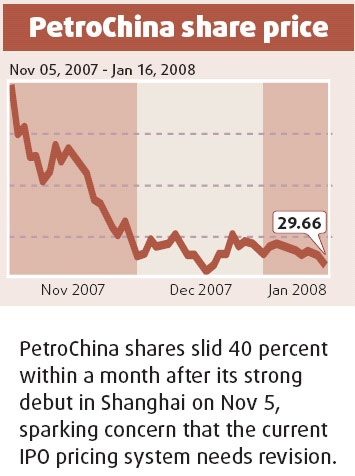
When shares slumped in PetroChina, Asia's most profitable company, after its stellar debut in Shanghai, mainland listing rules came under the spotlight.
Insiders said the fundamental problem is the rules governing initial public offerings (IPOs), which seem to favor institutional investors over individuals in the pricing and issuing of shares.
As a result, many individual investors who fail to obtain an IPO allotment must buy shares when trading begins. That rush for stocks has on many occasions pushed prices to unsustainable levels.
The China Securities Regulatory Commission and the Shanghai Stock Exchange at the end of last year assembled a group of stockbrokers and insurance companies for a one-day discussion to get their views on the issue in general and the poor performance of PetroChina's A shares in particular.
Shares in PetroChina opened at 48.6 yuan ($6.70) on November 5, and slid 40 percent to 31 yuan within a month. The sharp fall of China's largest stock also triggered a slide on the benchmark Shanghai Composite Index.
The phenomenon is not unique to PetroChina. The share prices of many other newly listed stocks have also nose-dived after initial spurts.
"These records show that the current pricing system has flaws, resulting in failure to establish a fair IPO price," said Gui Haoming, an analyst at Shenyin Wanguo Securities.
"There are vested interests influencing the prices of IPOs," said Wu Feng, an analyst at TX Investment Consulting Co Ltd.
The current rules, which took effect in September 2006, give three ways to subscribe to share issues: private placements to strategic investors, private special subscription for institutional investors, and open online subscription for individual investors. Institutional investors that subscribe for IPOs can count on getting an allotment in proportion to the size of the subscription, while only a small portion of individual investors' subscriptions are successful.
"The current issuing rules are not suitable in a bullish stock market, which entices many individual investors to try to snap up large quantities of IPO shares as soon as the company is listed," said Zhu Haibin, an analyst at Essence Securities.
Meanwhile, the large amounts of capital temporarily frozen in IPO subscriptions are seen to have a negative impact on financial market stability.
Liu Shiyu, deputy governor of the People's Bank of China, was quoted as saying that the government should restructure the pricing system in the financial market and review stock-issuing rules to minimize the impact on interest rates and the government bond yield curve.
Analysts said interest rate fluctuations have made it difficult for central banks to carry out monetary policies when commercial banks are faced with a sudden shortage of liquidity as it flows from bank deposits to IPO subscriptions.
Roughly 200 billion yuan of banks' financial products focus on IPO subscriptions, statistics show. The average annual IPO subscription from institutional investors - including mutual funds, State-owned firms, insurers and listed companies - amounts to around 2 trillion yuan.
Experts have suggested the government set up a monitoring system on pricing and adopt a market value or stock accounts-based allotment system to issue shares.
The market value allotment system, abolished in 2006, was based on the size of an investor's portfolio. For example, if an investor holds 10,000 yuan worth of circulating stocks, they can subscribe 100 shares in an IPO.
The system protects the interests of individual investors and dredges the large amounts of capital piled in the first-tier market to the second-tier market, experts said.
But Liang Yufeng, director of research at Orient Securities, said market value allocation, which was used to encourage investors to enter the bearish market two years ago, isn't suitable for the current bullish market that's overflowing with liquidity.
Analysts said the government can set the upper limits of subscription amounts for each investor, or allot IPOs based on the number of investor accounts.
They predicted the government would push forward regulatory reforms, as recently stated by Shang Fulin, China Securities Regulatory Commission chairman. "We will step up efforts to cultivate and form sound market operation, and push forward regulatory change and innovation, to ensure healthy development of the capital market," said Shang.
|
|