Phone of contention
Updated: 2007-12-31 17:03
Unicom is having a tough time. It has been operating cellular networks based on two different standards, GSM and CDMA, unlike China Mobile which uses only GSM. That has resulted in confusion in Unicom's strategies and its own two networks at times even compete with one aother.
Many analysts believe it could be the best option for Unicom to sell one network to China Telecom and merge another with Netcom.
Unicom, which before operated a GSM network, was mandated by the government to adopt the CDMA standard as a ticket to the World Trade Organization.
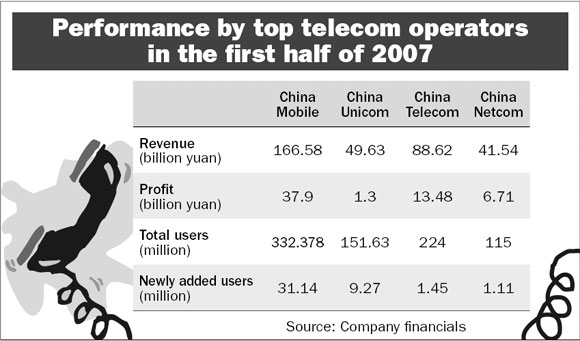
Unicom before held 35 percent of the mobile phone service market, but that has dropped to 20 percent. Bill Wang, chairman and chief consultant of CRC-Pinnacle Consulting, says the government is partly responsible for the decrease.
The increasingly weak competitiveness of China Telecom, Unicom and Netcom could be a stimulus for the government to finally put a restructuring proposal on the table.
Shi says the policy could become clear in 2008 due to the Olympic Games, as well as a change in March in the makeup of the State Council, China's Cabinet.
Wang Xudong, minister of Ministry of Information Industry (MII), last Thursday said at a conference that the ministry will push forward the policy in 2008 to enable all operators to run both fixed-line and mobile phone services.
The government has promised to offer the third-generation (3G) mobile phone services during the Games, which could mean it has to give the final word about consolidation in the industry before the games open.
Yet any decision might still be dragged out by disagreements among different ministries.
The MII, the NDRC and the State-owned Assets Supervision and Administration Commission (SASAC) all have a say in China's telecom restructuring and 3G licensing.
MII and NDRC are responsible for mapping out industry policies but SASAC is responsible for performance assessment of operators as well as their executives.
The SASAC has already engineered swaps of chiefs of the four State-owned operators and other executives, which surprised the market.
The major responsibility of SASAC is to avoid losses of the State-owned assets. But analysts say that could be used as an excuse by some to resist consolidation - contending the split of an operator could be a loss of so-called State-owned assets.


|
||
|
|