Processing no longer easy trade
Updated: 2007-08-13 08:56
The 150-odd workers are gathering toys in a race against time. They know their factory's days may be numbered. The owner of the three-storey factory at Fenggang Town in Dongguan is worried, too. He had never thought he would have to fold up his business in South China's Guangdong Province despite the worsening operational environment.
Vincent Ho saw his worst fears coming true after the central government issued a new policy on processing trade in late July. "It's not just my factory, but also a large number of small and medium-sized Hong Kong-funded processing units in the Pearl River Delta (PRD) region that face the same fate," he says.
Ho took over the reins of the factory from his father in 2000. He exports about 100 TEUs (twenty-foot equivalent units) of auto models to Europe, the Middle East and South Korea every year. "We have encountered several problems from 2002: power and labor shortages, rising prices of raw materials and new industrial standards set by the importing countries. But this time it's different, and I doubt if I can tide over this one."
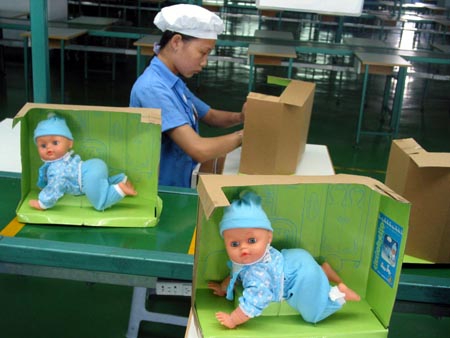 A worker processes toys at a factory in Chenghai, South China's Guangdong Province. The central government is making serious efforts to restrict the development of high energy and resource consuming and highly polluting industries such as toymaking. [newsphoto] |

To cut the exports of cheap, labor-intensive goods from the mainland further, the Ministry of Commerce announced last month that exporters would have to pay a deposit equal to half the amount they spend on importing 1,853 kinds of raw materials such as metal, plastic and textile products.
"If I sign a 4-million-yuan ($529,000), six-month contract with a trading company to import raw materials such as plastic and alloy, I would have to deposit 2 million yuan in my bank account and can get it back only after six months. For a low-profit company like ours, it's really difficult," says Ho.
|
|||


Hong Kong firms, many of them in the processing trade and exports, moved their workshops and production lines to the more business-friendly PRD region of the mainland, with more than 90 percent shifting their bases there.
"It was easy for my father to make money for some time," Ho says. "Time was when one looked at a person enviously if he said he was 'working for a Hong Kong company'." Jobseekers and government officials from almost all levels were happy to help develop Hong Kong-invested factories. For two decades Hong Kong manufacturers made hay under the favorable policies of the central government and preferential treatments of the local authorities. In return, of course, they created millions of jobs in South China.
More than 90,000 processing trade firms operate on the mainland. Nearly 70,000 of those are in Guangdong, out of which about 57,500 are Hong Kong-invested entities employing 9.6 million workers, according to the National Bureau of Statistics of China.


|
|