
Money flows from stocks to property
Updated: 2007-07-31 09:05
An increasing amount of investment capital is flowing from the depressed Chinese stock market to the relatively stable real estate markets in major cities like Shanghai, Beijing and Shenzhen, according to several banks and property consultancies.
Low- and medium-level residential properties have been attracting the bulk of the funds diverted from stocks, while luxury residential houses and office buildings are taking in a much smaller share, according to a recent survey by Shenzhen-based Worldunion Properties Consultancy (China) Limited.
The survey, which covers 16 real estate projects in Shenzhen, Beijing and Tianjin, estimates that funds diverted from stocks accounted for around 50 percent of the total transactions in low- to medium-priced residential properties from October 2006 to June 2007, 10 to 20 percent in luxury apartments and about the same percentage in office premises.
"The volatility of the stock market after the stamp tax hike in late May has also increased the potential risks and reduced the returns of stock investment, prompting many risk-averse investors to shift their focus to the property market," the Worldunion report said.
"It can be seen from the weak and uncertain performance of the stock market and the strong performance of property prices in various major cities," the report said.
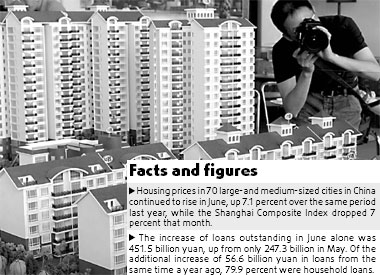
Housing prices in 70 large-and medium-sized cities in China continued to rise in June, up 7.1 percent over the same period last year, while the Shanghai Composite Index dropped 7 percent that month.
"From my experience in other markets, the risks of investment in real estate are relatively lower than that in the stock market," said Mao Zhi, a professor at China Real Estate Index Research Academy.
Some are even selling their stocks to pay for house loans before the recent lending rate hike of 27 basis points. These funds have indirectly flowed into the real estate market, analysts said.
"The interest rate hike is not expected to have a negative impact on the property market. The gap between long-term deposit and lending rates narrowed only 9 basis points after the rate adjustment, showing that the measure is not targeting the real estate market," said Li Maoyu, an analyst at Changjiang Securities.
At the macro level, the fund flow trend from stocks to real estate is reflected in the sharp increase in bank loans, economists and market analysts said.
According to statistics from the People's Bank of China, the increase of loans outstanding in June alone was 451.5 billion yuan, while it's only 247.3 billion in May. Of the additional increase of 56.6 billion yuan loans from the same time a year ago, 79.9 percent were household loans.
"Since the majority of household loans were mortgage loans, it's clear that more funds have been relocated to the property market lately," said Shen Minggao, an economist at Citigroup.

