BIZCHINA> News

|
BIZCHINA> News
|
|
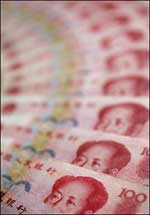
Yuan tending to further appreciation: experts
(Xinhua)
Updated: 2005-11-01 09:28 Almost all economists attending a recent seminar on the Chinese economy agreed the Chinese currency Renminbi (RMB) would be tending toward further appreciation in the long run.
The RMB has not been undervalued much, so the best choice is for the exchange rate to float within a small scope, said CCER Director Lin Yifu, quoted by Monday's China Securities Journal. However, Liang Hong, chief economist with the Goldman Sachs (China) Company, said the RMB's exchange rate has been undervaluedby at least 20 percent, which resulted in the rocketing of China'sforex reserve and the loss of national wealth. It is of huge risk for China's economic growth to largely depend on foreign trade and the international market, Liang said, suggesting an early upward adjustment of the RMB exchange rate. Since the early 1990s, the growth rate of the labor productivity in Chinese industries producing commodities that can be exported overran that of major developed countries, and so did the income of the Chinese people, said Lu Feng, a professor with the CCER. "So in theory, it is time for the RMB to appreciate," he said. According to a report released at the seminar, China's gross domestic product (GDP) is expected to grow 9.2 percent in the fourth quarter, and its consumer price index (CPI), export and import are expected to rise 1.6 percent, 24.6 percent and 22.3 percent respectively. Based on the the robust Chinese economy, Goldman Sachs has revised its prediction of China's GDP growth this year up to 9.4 percent, said Liang. Goldman Sachs also foresaw a 9-percent growth in China's GDP next year. Since M2, the broad measure of money supply, increases by about18 percent year-on-year in China, its CPI, an important index for inflation, is expected to grow 1.8 percent this year and around 2.3 percent next year, according to Liang. Lin, however, said due to the prevalent industrial overcapacity,the danger of deflation still exists. The rapid increase of M2 does not necessarily mean the disappearance of deflation, which may come in the fourth quarter this year or early next year, he said. Zhang Shuguang, chairman of the academic committee of the Tianze Economic Institute, suggested the government cut taxes so as to expand domestic demand and prevent deflation. In recent years, the government revenue kept growing at a rate of higher than 20 percent, exceeding that of citizens' income and GDP, said Zhang. The government fiscal revenue accounted for 19.3 percent of China's GDP in 2004, much higher than the level of 10.2 percent in1996, according to Zhang. But hyperactive growth in fiscal revenue, especially in taxes, could cause deflation and overheated investment, said Zhang, advising the government invest more in education, public medical service, employment and social insurance. "This is important to stir up domestic demand," he said. (For more biz stories, please visit Industries)
|