BIZCHINA> Comments & Analysis - Overseas

|
BIZCHINA> Comments & Analysis - Overseas
|
|
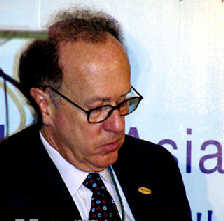
Chief economist: Revalue RMB 'a serious mistake'
(chinadaily.com.cn)
Updated: 2003-11-03 08:06 It would be "a serious mistake" to ask China to revalue its currency, said Stephen Roach, chief economist of Morgan Stanley at the 2003 Boao Forum for Asia (BFA) being held in South China's Hainan Island.
Roach said for more than a decade, foreign-invested enterprises, or the Chinese subsidiaries of global multinationals and joint ventures with industrial-world partners had accounted for 65 percent of the total increase Chinese exports over the period. Authoritative statistics showed that last year alone, a record US$52.7 billion of foreign direct investment flowed into China, making the country the largest recipient of foreign direct investment in the world. A big-cost industrial world had made a conscious decision that it needed China to enhance its competitiveness, said Roach. He pointed out that dismantling the RMB peg would destabilize the very supply chain that had become so integral to new globalized production models and exert serious negative impact on Japan, the US and Europe, which had led the rush to Chinese outsourcing. By putting pressure on China to change its currency regime, the industrial world ran the risk of squandering the fruits of its owncost-cutting efforts, said Roach. Roach's second argument in support of China's currency peg was the nature of the China's competitive prowess. Contrary to widespread perception, China did not compete on the basis of an undervalued currency. It competed mainly in terms of labor costs, technology, quality control, infrastructure and an unwavering commitment to reform. Third, Roach said China had consistently reiterated its long-term commitment to opening its capital account and making its currency fully convertible. To accomplish the objective, China had deepened its reform, but still a lot more needs to be done in capital-market reforms and the clean-up of the banking problems. "Until there is more progress on financial reforms. it would be premature and risky for China to float its currency in my view. That is a critical lesson of the Asian financial crisis of 1997 to1998 that an impatient world should not lose sight of when putting pressure on China," said Roach. Roach said the so-called Chinese export threat had overlooked the increased power of the Chinese import machine, a force that was putting China in an increasingly prominent role as a new engine on the supply side of the global economy. In the first nine months of 2003, Chinese imports were up 40.5 percent over the same period a year ago, the fastest annual increase of the last ten years. This powerful import dynamic was at the heart of China's "demand pull" on other nations in its supply chain, according to Roach. Roach said the Chinese growth engine was making a real difference in stimulating demand elsewhere in Asia and in the broader global economy. "I continued to believe that China is the world's greatest development story of the 21st century," he said. (For more biz stories, please visit Industries)
|