Tough going for foreign retailers
Updated: 2011-12-09 08:40
By Tang Zhihao (China Daily)
|
|||||||||||


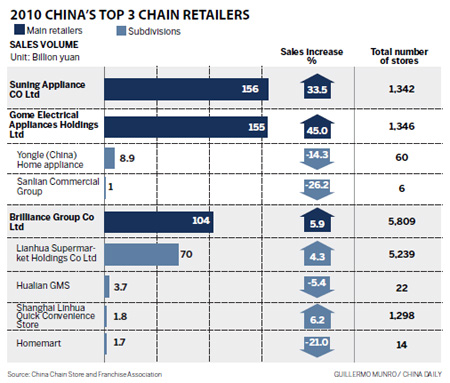
Figures from the China Chain Store and Franchise Association (CCFA) showed that in 2010, sales revenue generated by Taiwan-based RT-Mart reached 50 billion yuan, and the United States-based Walmart generated 40 billion yuan.
The two are the leading hypermarket operators in China.
For most foreign investors, China has become strategically important as any success here would mean they would have strong support for their growth.
Howard Abe, who specializes in consumer goods and retail practice at ATK, said retailers need to control the speed of their growth at a rational level to better control the supply and distribution channels. Companies also need to better understand consumer preferences and better utilize resources, he said.
Swedish furniture retailer Ikea has long had a test-and-trial strategy, and now is on an expansion phase after being in China for more than 10 years.
"We need to understand the market in China and understand what people like," Gillian Drakeford, Ikea China retail president, said. "We need to know the factors that can make us successful. We cannot just come in and suddenly go big."
ATK's Abe said: "No city is the same. Companies need to understand each city and understand consumer preferences."
When companies expand too quickly, he said, they might find it hard to find the right suppliers and maintain sustainable growth.
When competition in the larger cities gets too strong, many retail giants seek opportunities in smaller ones. However, not all have found this easy, with some larger giants forced to close stores in small cities to avoid further losses.
Peng Jianzhen, deputy secretary-general of CCFA, said foreign retailers have been doing very well over the past decade and have strong presence in cities such as Beijing and Shanghai.
However, their expansion might not have been as much as it was when they first moved into regional area, or smaller cities, Peng said.
"Locally retailing companies might have better control over resources in regional areas and some have developed management systems that better fit the local market, so foreign companies might lose competitiveness in second- or third-tier cities," Peng said.
After 10 years of growth, local companies have become more confident in competing with foreign companies and in building business models that better support development in China, Peng said. And compared with foreign companies, local companies might be more competitive in attracting talent.
"Many local companies have share option plans for staff, so it is easy for them to attract excellent people," said Peng. "For many foreign companies, it might not be the case."