Rapid gains, but challenges ahead
Updated: 2011-12-09 08:37
By Diao Ying (China Daily)
|
|||||||||||


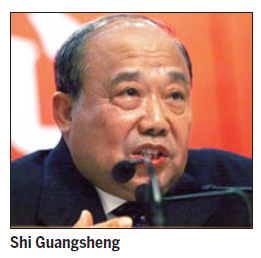
When former commerce minister Shi Guangsheng signed the WTO documents on behalf of China in December 2001, it was the end of 15 years' of marathon negotiations and sleepless nights. But for China, it was the beginning of a new era, with many significant achievements and unprecedented challenges.
"China has dealt with all kinds of challenges in the past 10 years. Its economy has developed rapidly, and the world has benefited from it," said Shi in a recent interview with China Daily.
The greatest benefit for China has been its rapid economic development, while its economic development has benefited the world, Shi said. China's share in global exports has risen from 4.3 percent in 2001 to over 10 percent by 2010. Its proportion in the world GDP has also grown. In 2002, it accounted for 4.4 percent of the global GDP, while it was 9.3 percent in 2010. China is now the biggest contributor to global exports and the second largest importer.
When China entered the WTO in 2001, it also helped change the structure of the world economy. It is now playing an increasingly important role in the IMF (the International Monetary Fund) and the World Bank. The developed countries had till then dominated the WTO because of the differences in economic strength between rich countries and developing nations. Before 2001, decisions within the multilateral organizations were mainly made by the US, Europe, Japan and Canada.
But emerging countries have now become the main players helped largely by China's WTO entry. Countries and regions like Brazil, India, the US, the EU, Japan and Australia are now the core players in multilateral organizations. "As a result, the WTO now reflects the interests of developing countries, and this is a significant change," he said.
"If China was not a WTO member, its impact would not have been as significant as it is today," said Shi. "And this also reflects the significance of the event." The participation of China also helped the world trade system to become more fair and reasonable. "China participated in the Doha Round Talks, and insists on protecting its own rights as well as the rights of other emerging countries."
But the WTO has also brought challenges to China. "Chinese companies have to compete with foreign players, and the government has to change its management method," Shi said. "The experiences show that we have done a good job in dealing with these challenges," he said. Instead of shrinking as a result of competition, China's domestic market has expanded in the past 10 years. The total retail sales of consumer goods has gone up to 15.45 trillion yuan ($2.43 trillion) in 2010, up from 3.7 trillion yuan in 2001. Chinese enterprises have also become stronger through competition.
In 2001, there were only 11 Chinese firms in the world's 500 top companies, and now there are 54. The economic structure has improved, and product quality is also getting better.
"The way the government is managing the economy is also changing. It is gradually adjusting to a more market-oriented economy," he said.