 |
|
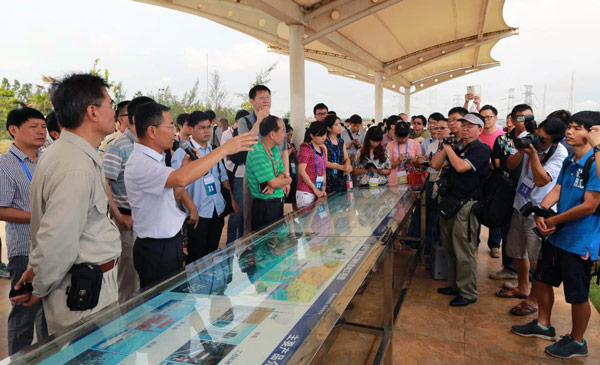
Wang Zhongbing (second left) shows the Baosteel Zhanjiang plant to guests attending the Forum on Internet Media of China held in Zhanjiang on July 17, 2015. [Photo/China Daily] |
Editor's note: Wang Zhongbing, 51, has been mayor of Zhanjiang for five years. He wants to transform the southernmost city of Guangdong province into another southern economic powerhouse alongside cities such as Foshan and Dongguan, and he has successfully courted a number of State-owned petrochemical, steel and papermaking giants to settle in the city. But Wang's vision encompasses the environmental and social implications of development on such an unprecedented scale as well, and he wants the transformation to also turn Zhanjiang into an eco-city. Wang tells Zhao Huanxin more in this Q&A session.
After two years of construction, Baosteel's massive steel and iron plant in Zhanjiang begins trial operations in September, at a time when the industry is beset by overcapacity and there are growing concerns about the industry's impact on environment. How will it overcome these headwinds?
It must be noted that the new plant, with an annual output capacity of 10 million tons of top-quality steel, has been accompanied by the phasing out of 16.1 million tons of obsolete capacity in steel production in the whole of Guangdong province. As the strategic upgrade of the Baosteel Group's 30-year-old, Shanghai-based plant, the Zhanjiang plant is endowed with an unrivaled logistics advantage, namely the deepwater Zhanjiang Port that makes the transport of iron ores from Australia and Brazil and exports of finished products to southern China, Southeast Asia and beyond more cost-effective than almost anywhere on the mainland.
Meanwhile, there has been a massive investment to make the steel plant as environmentally friendly as possible. Based on the current budget, for each one ton of steel produced at least 700 yuan ($113) is being spent to minimize the discharge of pollutants. We have also made breakthroughs that turn the waste and other byproducts from either the steelmaking or petrochemical plants-which are 500 meters apart on Donghai Island-into the raw materials and energy for the other. We call that the circular economy.
I have confidence in this State-owned steel company. I'm sure people will still be able to still relish seafood worry-free after these modern industrial complexes go into full operation in Zhanjiang.
You were a blast-furnace man 30 years ago, shoveling raw materials into the furnace for two years. Last week, you pushed a button to start the trial operations of the plant's converter. How have things changed over the years?
There has certainly been a sea change in China's manufacturing sector over the past three decades. Still, I miss the days when I enjoyed the cool evenings with my co-workers beside a simple fan after sweating for a whole day by the blast furnace.
Slightly more than a century ago, the French occupied the port of Zhanjiang, which was then a minor fishing port. It was returned to China in the late 1940s. How has the port developed and what are its prospects?
Zhanjiang Port as we see it now was one of the first key projects undertaken during China's first Five-year Plan period (1953-1957). It is China's first, self-designed modern port. Before the 1980s, it was used for exports of materials to support countries in Asia, Africa and Latin America, and for imports from a limited number of countries such as Poland.
It took the port 18 years to increase its cargo throughput from 10 million metric tons to 100 million, and then six years to increase the throughput to 200 million metric tons. In a few years, we anticipate the throughput capacity at Zhanjiang Port will expand to 300 million metric tons, and the port channels will be expanded so vessels of 400,000 tons can berth. At present, the maximum is 300,000 tons.
The port boasts the shortest route from the Chinese mainland to Southeast Asia, Africa, Europe and Oceania. You can imagine its prospects now the country has launched its Belt and Road Initiative, a trade and infrastructure network that will connect Asia, Europe and Africa.

Copyright 1995 - . All rights reserved. The content (including but not limited to text, photo, multimedia information, etc) published in this site belongs to China Daily Information Co (CDIC). Without written authorization from CDIC, such content shall not be republished or used in any form. Note: Browsers with 1024*768 or higher resolution are suggested for this site.
License for publishing multimedia online 0108263 Registration Number: 130349