China's VR industry tumbles after explosive growth
 |
|
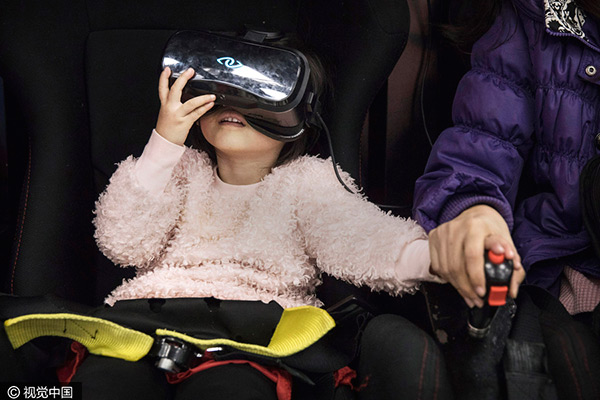
A Chinese girl wears virtual reality glasses (VR) as she sits on a roller coaster simulator at the Wantong VR Park, which claims to be China's largest, November 27, 2016 in Beijing. [Photo/VCG] |
When Fang Wenxin founded a virtual reality (VR) firm in 2015, he never expected the industry would go bust so soon.
The boom in China's VR industry following Facebook's $2 billion buyout of Oculus, a US producer of VR gadgets and computer games, in 2014 has declined, with about 90 percent of start-ups in the domestic market declaring bankruptcy.
"There were about 200 to 300 firms engaged in producing VR helmets in 2015, but now no more than 10 companies remain functioning," Fang said.
During the past few months, domestic VR companies, such as Storm Magic Mirror, Miido and AlfaReal, started to downsize organizations or delay payments of employee salaries due to a diminution in venture capital.
According to the latest report issued by iiMedia Research, a third party data collector and analyst of technological digital platforms, the supply of high-end smart glasses in the domestic market has failed to lure consumers, with more than 70 percent of respondents among smart cell phone users expressing no willingness to buy one.
Taken up by gigantic tech firms, such as HTC, Facebook and Sony, the market for VR hardware has left slim chances for smaller manufacturers to slot in, so that the VR businesses of domestic manufacturers focus mostly on content production.
However, despite the increasing involvement of VR start-ups, cheap copycats have eaten up the market, blocking the channels necessary for high-end innovation to reach customers.
The slump in the VR market during the second half of 2016 in China is probably the result of deficient industrial innovations, said Wu Limei, an analyst of the iiMedia Research.
But the recent fall of the VR industry may be less ominous than a sign of industrial recession when the frenetic flows of capitals have cooled down.
Zhao Ziming, an analyst from Analysys, Ltd., an agent of data collection and analysis, said the industry will be reshuffled by the entries of big companies, like BAT and NetEase, following the bankruptcies of small companies with broken capital chains. The threshold will be elevated and the money will be spent more reasonably.
Investment in the Chinese VR industry soared to 270 million yuan ($38.9 million) in 2014, a robust rise followed by 2.4 billion yuan in 2015 and 1.54 billion yuan in the first half of 2016.