Zhang Yu, a managing director of Shanghai-based consulting firm Automotive Foresight, told China Daily that the move goes against the principle of free competition and "will kill innovation".
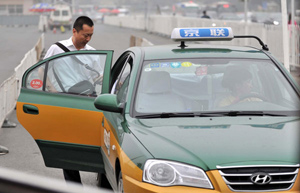
Another controversial component in the notice is the proposal that all taxi-calling tools be integrated into a uniform system run by the transport ministry, which would distribute customer orders to terminals installed in taxis. Those who refuse to join the system will be banned, said the proposed regulation.
While Kuaidi developer and operator Hangzhou Kuaizhi Technology Co was not available for an interview, an executive at Beijing Xiaoju Technology Co, which runs Didi, said he is worried about the performance of the suggested integrated system.
"A single, uniform platform means it cannot be updated frequently and more importantly it will kill the core competitive edge of taxi-hailing apps - the accurate order distribution capacity empowered by big data," said Xiaoju Technology Vice-President Wang Xin in an interview with the Guangming Daily.
Yang Yingjun, a researcher at the transport ministry, told the newspaper that the integrated system is meant to help supervision, but will not change taxi-hailing apps' functions or competition.
Yet Wang said terminals in taxis "are inferior to mobile phones because both drivers and passengers can frequently update software in mobile phones".
Many taxi drivers and passengers said they would like less government interference, as they have no idea of what the so-called uniform system would be like.
"I prefer to keep the existing apps," said a Beijing-based taxi driver surnamed Sun.
"They indeed help us pick more passengers and the mobile payment enabled by the apps has reduced the chance of receiving fake money," said Sun.
A 2014 survey by Tsinghua University showed that 90.3 percent of 514 polled taxi drivers in six cities said the apps have helped them cut driving in search of a fare. Fifty-five percent said their monthly income has risen by 10 percent to 30 percent.
Fares are also mentioned in the notice. Despite widespread agreement that taxi drivers should not ask for extra money, many said it is another option to call a taxi by offering tips.
Zhang Lan, a translator in Beijing, said it actually helps distribute the resources to those who need it most.
"If you live in remote areas where taxis are rare and have an emergency like taking sick family members to the hospital, offering tips can cut your time waiting," said Zhang.
Liang, who will continue cooking until the end of June, said she will take advantage of this time to take a taxi to the market because "nobody knows whether hiring a taxi will remain so easy when the ministry's notice turns into law".
|
 |
 |

Copyright 1995 - . All rights reserved. The content (including but not limited to text, photo, multimedia information, etc) published in this site belongs to China Daily Information Co (CDIC). Without written authorization from CDIC, such content shall not be republished or used in any form. Note: Browsers with 1024*768 or higher resolution are suggested for this site.
License for publishing multimedia online 0108263 Registration Number: 20100000002731