 |
|
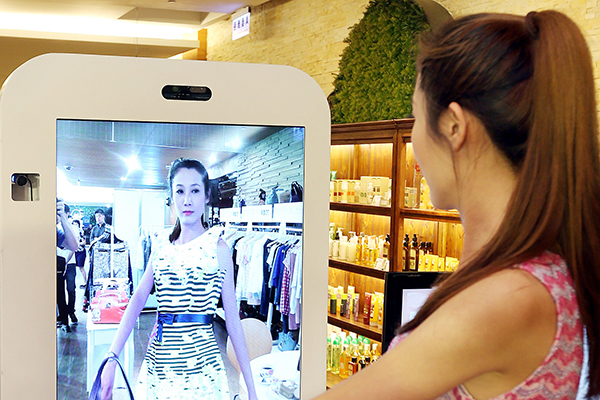
3-D fitting rooms provide a magical shopping experience for customers in a shopping mall in Taiwan. [Photo provided to China Daily] |
Recent reports that a new plaza offering a 24-hour shopping experience is enjoying brisk business in an eastern city has led me to expect that more such bricks-and-mortar outlets will spring up in other cities.
The Taihe Plaza, built at a cost 2 billion yuan ($299 million) and covering 1.5 million square meters in Fuzhou, with a population of 6 million and capital of Fujian province, received 2 million customers in the first three days of its opening in late 2015 and is attracting an average 100,000 customers a day.
Designed as a world-class comprehensive shopping center catering to customers of all ages, providing top brands and a rich variety of leisure products and services, its immersive shopping environment and business model may give inspiration to the traditional domestic retail industry, which is struggling to survive.
I would like to see this business model triggering a new lifestyle for urban residents in China.
Though more people are embracing e-commerce and becoming big spenders online, I believe the majority of consumers, myself included, have a deep-rooted passion for bricks-and-mortar shopping, which offers a zero-distance experience of touching, feeling, tasting, smelling, and naturally wearing the products.
I would like to spend part of my weekends buying things, window shopping or drinking coffee at a bar with nostalgic background music at a place like the Taihe Plaza, which has arrested the hearts of many addicted online buyers with its comprehensive shopping experience, according to local reports.
But maybe it is still early for the Taihe Plaza to call itself a world-class outlet.
Some commercial outlets in developed countries, such as the New York's Herald Square, have actually become lifestyle centers. Apart from providing comprehensive products and services, including entertainment, music bars, bookstores, hairdressers and restaurants, they have also adopted online-to-offline modes, or O2O, and virtual-reality and augmented-reality technologies, which enable their customers at the shop to view and even "wear" all the products of a certain brand.
By converging with e-commerce and latest technologies, bricks-and-mortar stores can survive the intensifying competition with e-commerce. About 700 million Chinese urbanites, one-third of them middle class, will welcome such convergence.
Also, the central government has initiated a policy for social institutions and companies to ensure that their staff can fully enjoy their annual vacations, creating more leisure time and demand. These conditions will make people thirsty for new style weekends that combine shopping and enjoying various services.
The booming of e-commerce is blamed for the bankruptcy of thousands of big and small physical stores or shopping malls, including overseas retail brands.
A 2012 CCTV debate on e-commerce between Jack Ma, chairman of e-commerce giant Alibaba Group Holding Ltd, and Wang Jianlin, chairman of Dalian Wangda Group, China's leading property developer and retailer, highlighted the fight that is going in depth between e-commerce and traditional retailing.
Ma said e-commerce will make up 50 percent of the country's retail sales by 2020, while Wang said he would bet 1 million yuan that Ma is wrong.
However, according to media reports, both of them have made much greater efforts to develop e-commerce. On the other hand, both have unveiled plans and are building new offline sales models to offer customers a new shopping experience.
Official statistics show online retail sales, at 4 trillion yuan in 2015, are still far behind the traditional retail industry, which racked up 38 trillion yuan. Yet, I am sure e-commerce will catch up quickly, as the convergence of the internet with nearly all industries is accelerating fast.
So it is highly possible that there won't be a loser in the Ma-Wang bet. Instead, both of them will be winners as the retail sector has entered an era of integrated business models.
Addressing an international expo on big-data industry in October, Ma of Alibaba said the life of humankind will be full of marvelous things in the coming 30 years.
That certainly will include new creative retailing models that will further revolutionize our shopping lifestyles with endless joys and benefits.


Copyright 1995 - . All rights reserved. The content (including but not limited to text, photo, multimedia information, etc) published in this site belongs to China Daily Information Co (CDIC). Without written authorization from CDIC, such content shall not be republished or used in any form. Note: Browsers with 1024*768 or higher resolution are suggested for this site.
License for publishing multimedia online 0108263 Registration Number: 130349