 |
|
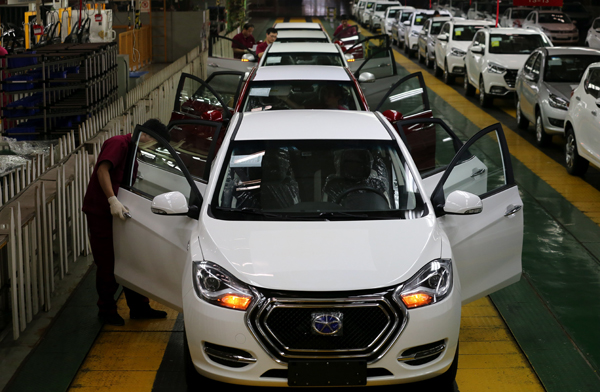
Rows of new energy vehicles roll off the production line at a Chinese automaker's plant in Anhui province. Xu Congjun / For China Daily |
The Chinese government is considering introducing a carbon credit regulation scheme next year as part of a detailed and practical plan to assess the efforts made by automakers towards cutting greenhouse gas emissions.
According to a draft regulation that was released earlier this month, carbon credit will be calculated according to the amount of reduced carbon dioxide emissions from the use of new energy vehicles manufactured in or imported to the country.
The credits should be handed in before the end of the year to the agency under the State Council, and extra credits traded on the nation's official carbon credit market, due to be rolled out in 2017.
Automakers who expect to produce more carbon emissions than agreed will be able to either purchase credits on the market. Failing to hand in the required credit after a certain buffer time, would end up with their following year's credits reduced according to the excess emissions produced. Each credit in short would incur a penalty, charged at three to five times the previous year's annual average credit price.
"This is an executable plan, which includes sanctions, to assess how carmakers are progressing with their carbon dioxide emissions reduction plans, said John Zeng, head of the Shanghai-based LMC Automotive Consulting.
He added: "The country will have a detailed and practical system to oversee the development of new energy vehicles. There is currently no assessment method or system of sanctions for automakers who fail to meet targets."
A company may earn credits by producing or importing fully electric, plug-in hybrid, fuel-cell cars, but mild hybrid cars will not earn any carbon credits. For example, the Toyota Prius, which is said to be the world's best-selling hybrid model, will not generate a single carbon credit under the government's proposed scheme.
Zeng said the draft scheme is consistent with the country's existing new energy vehicle industrial policies, and a specific calculation method would be needed.
"China is constantly encouraging fully electric, plug-in hybrid, fuel-cell vehicles, and the country's carmakers have already have expertise (in developing them)," he said.
He continued: "The carbon credit scheme should be consistent with the fuel consumption cap of 5-liters per 100 km by 2020. A conversion could be made between carbon emissions and fuel consumption."
A fine ranging from 100,000 yuan ($15,052) to as much as 1 million yuan has been proposed for automakers that report false carbon credit information.

Copyright 1995 - . All rights reserved. The content (including but not limited to text, photo, multimedia information, etc) published in this site belongs to China Daily Information Co (CDIC). Without written authorization from CDIC, such content shall not be republished or used in any form. Note: Browsers with 1024*768 or higher resolution are suggested for this site.
License for publishing multimedia online 0108263 Registration Number: 20100000002731