|
 |
|
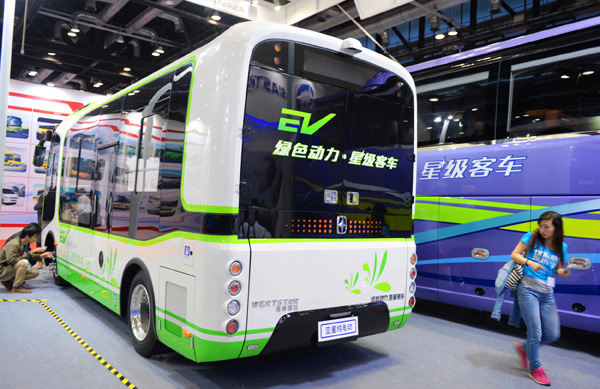
More new-energy buses will be put into public service across China. [Photo/China Daily] |
330 models of new-energy vehicles will be available in tax-free policy
China, the world's second largest new-energy vehicle market, is once again making the purchase of a new-energy vehicle much easier and lighter on customers' wallets.
The Ministry of Industry and Information Technology and the State Administration of Taxation recently announced that 330 models of new-energy vehicles can be purchased free of tax. Officials said the move would help boost the development of the new-energy vehicle industry, transform the transportation and energy sectors and help protect the environment.
This is the fourth time that the central government has rolled out a tax-free purchasing plan for new-energy vehicles, following moves in August, October and December.
The list of available new-energy vehicles include 295 pure electric models and 35 plug-in hybrids. Among the pure electric autos are 26 models of passenger car, 191 buses, 77 special-purpose vehicles and one van; plug-in hybrid models include two passenger cars and 33 buses.
The list only consists of Chinese brands and joint-venture brands, such as BAIC, BYD Auto, Geely and Foton Motor.
In a separate measure to put more electric buses on city streets, the Ministry of Finance, Ministry of Industry and Information Technology and Ministry of Transport last week jointly issued an updated policy on fuel subsidies for public buses. The ministries, which currently pay the cost of fuel for public buses in China's cities, will reduce fuel subsidies every year through 2019.
The hope is that the move will force cities to replace their public buses that run on fuel with new-energy models.
Ten cities and provinces will follow the new policy, including Beijing, Shanghai and Tianjin, as well as Hebei, Shanxi, Jiangsu, Zhejiang, Shandong, Guangdong and Hainan provinces.
Local Chinese governments have also undertaken moves of their own to put the central authority's preferential policies on new-energy vehicles into action.
Earlier this month, Beijing's development and reform commission set up a service price standard for charging electric cars, setting the price for every kilowatt of electricity the new-energy vehicle uses to no more than 15 percent of one liter of gasoline with a minimum octane rating of 92.
The service rate will go into effect from June 1 and operators of charging stations for electric autos will collect the fees. The city commission said that fees at charging stations will be adjusted to market prices on Jan 1, 2020.
The Beijing government agency said it hopes the service price standard will attract more capital to the construction of new-energy vehicle infrastructure.
"I believe the infrastructure construction of new-energy cars will improve very quickly-once the government sets up a rule, the market will do the rest," said Bao Wenguang, CEO of Xindayang Electric Vehicle Technology Co Ltd, a domestic electric car manufacturer.

Copyright 1995 - . All rights reserved. The content (including but not limited to text, photo, multimedia information, etc) published in this site belongs to China Daily Information Co (CDIC). Without written authorization from CDIC, such content shall not be republished or used in any form. Note: Browsers with 1024*768 or higher resolution are suggested for this site.
License for publishing multimedia online 0108263 Registration Number: 20100000002731