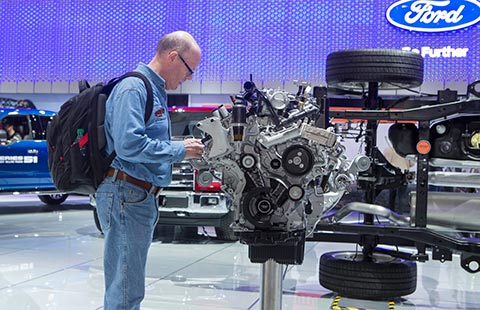
As part of their effort to improve fuel efficiency and meet the more stringent standard, many domestic carmakers are now working on small-displacement, turbo-charged engines to be used in more of their lineup.
One shortcut is buying advanced components from international manufacturers, said analysts.
But the cost would greatly increase as well, a trend Chinese automakers cannot afford due to their already low profit margins, the industry observers said.
Imported brands
Imported brands will also be affected because imported vehicles must comply with the standard without using locally made products when calculating their fleet average.
Imported vehicles are generally bigger than locally produced models. Even though they produce large volumes locally, German luxury carmakers Audi, BMW and Mercedes-Benz also import their large sedans and SUVs to China.
Some foreign brands are solely imports, and most of their lineup are vehicles with big engine displacements. The imported Jeep uses engines of up to 6.4 liters, with 2-liter displacement the smallest in its current portfolio.
Analysts said that import-only carmakers will have to adjust their lineup and bring more cars with small engines to China.
While the new regulation has risks for a range of carmakers, some will benefit from their dedication to new-energy vehicles.
According to the ministry, to encourage sales of all-electric, plug-in hybrid and fuel battery vehicles, each such product can be weighted by a factor of five in the calculation. Additionally, hybrids and other energy-saving vehicles with fuel consumption below 2.8 liters every 100 km can carry a factor of three.
Last year, the Chinese government issued a blueprint on the development that called for manufacturers to have an annual production capacity of 2 million all-electric and plug-in hybrid vehicles by 2020, when the cumulative output and sales should total 5 million units.
By promoting new-energy vehicles, the government said that average fuel consumption of all passenger vehicles made in 2020 will be reduced to 5 liters per 100 km.
China became the world's biggest car market in 2009 on sales of more than 13 million vehicles. In the next two years, sales surpassed 18 million units and reached 19 million last year.
By the end of 2012, there were 100 million automobiles on the road in China.
According to MIIT, automobiles account for about 55 percent of the diesel fuel and gasoline now used in the nation. More than 70 percent of the increase in oil consumption is now from additional vehicles on the road, the ministry said.

Copyright 1995 - . All rights reserved. The content (including but not limited to text, photo, multimedia information, etc) published in this site belongs to China Daily Information Co (CDIC). Without written authorization from CDIC, such content shall not be republished or used in any form. Note: Browsers with 1024*768 or higher resolution are suggested for this site.
License for publishing multimedia online 0108263 Registration Number: 20100000002731