Seeds of innovation
Updated: 2011-05-23 09:17
By Yang Yang (China Daily European Weekly)
|
|||||||||


Six years ago, Dutch floriculture company Anton Verbeek New Roses International first sold its rose variety "Attracta" to Kunming Hai Yu Gardening Co Ltd, charging 0.8 euro for each seedling as royalty.
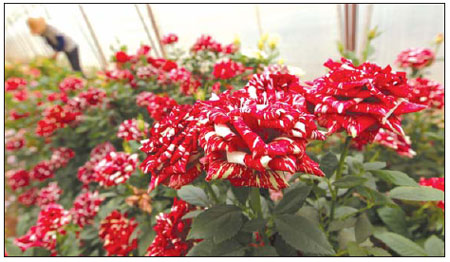
Compared with the average seedling price of 0.4 to 0.5 yuan (0.04-0.05 euros) for common varieties, the royalty seemed very high.
But on Valentine's Day in 2006, the wholesale price of each fresh cut "Attracta" flower in the Kunming International Flora Auction Center hit 14 yuan, and on Valentine's Day in 2007, its retail price surpassed 200 yuan.
On Valentine's Day this year, the new rose variety hit a record wholesale price of 18 yuan each. Its retail price was 10 to 20 times higher.
"Although the royalties of new plant varieties are relatively high, their prices are generally two to four times that of the old ones," says Lu Jiliang, a researcher with the flower industry office of Yunnan province.
The Attracta case shows how innovation can make a significant difference in a traditional sector.
In past decades, Yunnan's flower industry relied mainly on imported varieties and seedlings.
At the beginning of the century, when Yunnan flowers became increasing popular in the international market due to low prices and good quality, European producers refused to sell their fine varieties to the province.
They feared that their products developed through decades of effort would be spread quickly in China without reaping the requisite royalties.
"But the situation has been improved greatly. More flower companies are willing to pay high royalties for fine varieties to make large profits," says He Kui, deputy director at the province's flower industry office.
While European companies including leading rose grower Meilland International are still expected to lead in the research and development (R&D) of new products, Yunnan has been trying to make a mark in the world's flower market.
In 2004, major rose producer Kunming Yang Chinese Rose Gardening Co Ltd gained the country's first new commercial flower variety patent - the "Bing Qing Rose".
During the 2008 Beijing Olympics, the "China Red" roses bred by Lidu Flower Development Co Ltd also brightened the faces of many athletes standing on the podium.
Last year, the brand "Ashima" (the name Yi-ethnic people call their girls, indicating 'beautiful, kind and brave'), the fruit of the cooperation between the Yunnan Academy of Agricultural Sciences and Yunnan Jinyuan Flower Industry Co Ltd, colored the Shanghai 2010 Expo as the designated reception flower.
"Scientific innovation is key to the development of the flower industry," says Wang Jishi, director at the Institute of Flowers at the Yunnan Academy of Agricultural Sciences.
Since its establishment in 2004, the institute has been working with local flower companies to develop new plant varieties. It holds 80 patents on its products, Wang says.
Up to 80 percent of China's new patent varieties are developed in Yunnan, he says.
"If a flower company wants to grow, it must have its own types with independent intellectual property rights (IPR)," says Du Fushun, vice-president of Kunming Jinyuan Flower Industry Co Ltd.
The company is competitive in growing carnations and roses. By March of 2010, Jinyuan had developed 37 patent plant varieties, 62 percent of the province's total.
Kunming Yang Chinese Rose Gardening Co Ltd owns 15 patent rose varieties. This year, it plans to patent another three new rose varieties.
Compared with the mature flower industry in Europe, Yunnan flowers still have a long way to go, especially in R&D and the protection of IPR.
"Europeans have rich flower breeding experience of more than 100 years, and we only started 16 years ago," Wang says.
"China did not invest enough in the R&D of new varieties. The most important thing for China in the past decades was to feed people. And Chinese people were not willing to spend money on flowers, especially expensive ones," he says.
"But with the development of China's economy, the flower industry is getting more attention from the government and people. We can learn from the experience of our foreign counterparts."