Water flows demonstrate the 19th century British economist David Ricardo's theory of comparative advantage. China's southern provinces have advantages over the north in both industry and agriculture. But their comparative advantage is greater in industry, so the south has specialized in industrial production and forced the north to specialize in farming.
As provinces and cities along the eastern seaboard have become ever more dominant industrially, farm production has been driven into the drier areas of the north and west.
|
 |
 |
The key change over the last three decades, as the researchers explain, is that the south has become much better at industrial production, rather than the north becoming better agriculture.
Xinjiang, which has annual rainfall of less than 10 centimeters, exports billions of tons of water each year to Shanghai (where annual rainfall is 1 meter or more) and Guangdong (which receives 2-3 meters per year).
Farming accounts for 98 percent of water consumption in Xinjiang, 84 percent in Inner Mongolia and 83 percent in Hebei, compared with just 67 percent in Guangdong and 31 percent in Shanghai ("Virtual scarce water in China: supplemental data" June 2014).
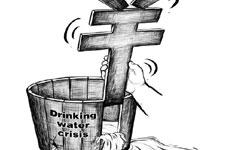
Industrial and water imbalances are worsening China's environmental problems. Northern China is already subjected to dust storms and far worse pollution than the south. Now the region is suffering from increasing water stress.
For example, Zhejiang is a major exporting province on China's east coast. But only 20 percent of the ecological impact of Zhejiang's exports was felt in the province, according to the researchers, while the rest was "outsourced" to other parts of China, including Xinjiang (40 percent), Hebei (7 percent) and Inner Mongolia (5 percent).
Increased use of irrigation and reliance on groundwater have enabled northern provinces to boost agricultural output, but is not sustainable in the long term as regional aquifers fall.


Copyright 1995 - . All rights reserved. The content (including but not limited to text, photo, multimedia information, etc) published in this site belongs to China Daily Information Co (CDIC). Without written authorization from CDIC, such content shall not be republished or used in any form. Note: Browsers with 1024*768 or higher resolution are suggested for this site.
License for publishing multimedia online 0108263 Registration Number: 130349