Every year, about 200,000 hectares of land is destroyed by the country's 112,300 mines, said Wu Haiyang, director of the Land Reclamation Center at the Ministry of Land and Resources.
Of all the land destroyed by mining activities, 80 percent was ruined by coal mining, according to the Land Reclamation and Ecological Restoration Committee of the China Coal Society.
"Farmland accounts for more than 60 percent of the land damaged by production, while large areas of wasteland can result in soil contamination, environmental degradation and the loss of biological diversity," Wu said.
|
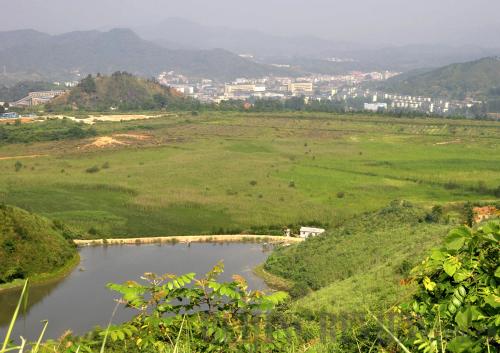 The No.1 tailing pond of the Dexing Copper Mine in Dexing city, Jiangxi province, has turned into a green field after 30 years of reclamation efforts. [Photo / Xinhua] |
Official statistics show that presently, 25 percent of the wasteland created by industrial processes have been reclaimed, which is significantly higher than the national average reclamation rate in the 1980s, when it was a paltry 2 percent. Nonetheless, at the end of 2009, more than 6.7 million hectares of abandoned mining sites remained unclaimed.
If these abandoned mining sites are left to recover by themselves, it will take at least half a century for vegetation to restore, and if topsoil has been completely removed, the recovery process will be even longer, experts say.
Incentives
To ensure that land ruined by production activities will be reclaimed, the Chinese Government has introduced several laws and regulations on the issue. Among them, rules issued in 1988 stipulate that "whoever damages the land should reclaim it."
Yet for a long time, some local governments stubbornly pursued gross domestic product growth while businesses single-mindedly sought profit, so they did not attach importance to the sustainable use of land resources and as a result land reclamation rates remained low.
In recent years, however, this situation has begun to change due to the rising public awareness of the need for environmental protection and ecological conservation.
In March 2012, the State Council, China's cabinet, released a national land restoration plan for 2011-15, setting the goal of achieving a 100-percent reclamation rate for land newly damaged by industrial production and a 35-percent reclamation rate for land damaged by production occurring in the past.
While conducting research, the Ministry of Land and Resources found that the primary reason for wasteland not being reclaimed was that the obligated party did not want to accept the financial responsibility, so they instead put the burden on the government, said Wang Shouzhi, director of the ministry's Policy and Regulation Department.
In response, the State Council proclaimed the Regulations of Land Reclamation in February 2011. In order to facilitate the implementation of the regulations, the Ministry of Land and Resources produced detailed measures, which went into effect on March 1.
The regulations say that the party responsible for land reclamation must add the consequent costs to their production budgets or a project's planned investment.


Copyright 1995 - . All rights reserved. The content (including but not limited to text, photo, multimedia information, etc) published in this site belongs to China Daily Information Co (CDIC). Without written authorization from CDIC, such content shall not be republished or used in any form. Note: Browsers with 1024*768 or higher resolution are suggested for this site.
License for publishing multimedia online 0108263 Registration Number: 130349