| ?
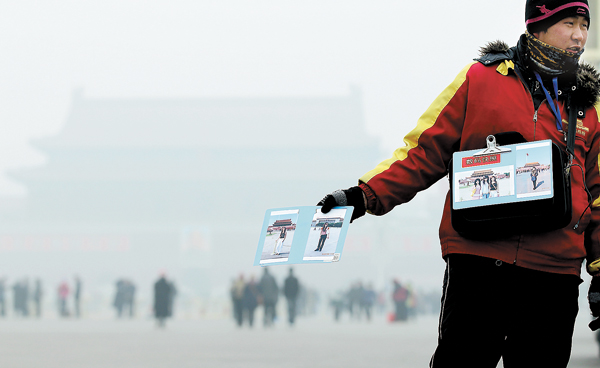 The clear sky over Tian'anmen Square, depicted in a photographer's work, is in sharp contrast to conditions on Tuesday. [Wang Jing/China Daily] |
Thick smog and haze shrouded large areas of China on Tuesday for the fourth time this month, again provoking heated discussions over government measures that seem ineffective.
But tackling air pollution requires input from individuals as well as officials, experts say, though an environmental NGO points the finger at the economic structure.
The air pollution covered an area of 1.3 million sq km in central and eastern areas on Tuesday, including Beijing and Hebei, Shandong, Shanxi and Jiangsu provinces, according to the Satellite Environment Center of the Environmental Protection Ministry.
In a recent survey of 7,000 people from 31 provinces, conducted by China Youth Daily, more than 90 percent of respondents believed that air pollution had a major effect on their lives.
About 85 percent of respondents expected emergency plans to be initiated by the government but only about half felt that they could take measures themselves to improve air quality.
Xiao Yan believes that individuals can play a role in combating pollution. The 30-year-old lawyer in Beijing uses public transportation when going out, instead of driving or taking a taxi.
She said she learned about how much individuals can tackle sources of PM2.5 — particulate matter smaller than 2.5 microns in diameter that can enter the lungs and bloodstream — through using buses and trains on an NGO's website.
"Vehicle emissions are not much less than those from industry," Xiao said. "Using public transportation may be inconvenient, but it is worth it."
But her low-carbon lifestyle is not appreciated by her colleagues and friends. Some even mock her.
"Everyone is responsible for creating air pollution. No one will act if we all just place our hopes in others," said Du Shaozhong, director of the China Beijing Environment Exchange.
He said when it comes to policies, such as vehicle controls, there is always resistance from the public because no one wants to give up their rights.
Vehicle emissions have replaced industrial pollution as the biggest contributor to airborne pollution in major Chinese cities, according to research by Zhuang Guoshun, a professor at Fudan University's Atmospheric Chemistry Research Center.
Wu Xiaoqing, vice-minister of the Environmental Protection Ministry, has also emphasized the growing importance of pollution from vehicles.
But in a recent online survey conducted by China Auto Market Magazine, more than 60 percent of the 4,000 participants did not agree with the policy to charge congestion fees.
"For car owners who still drive into the city center on heavily polluted days, a congestion fee or pollution fee should be charged," said Chai Fahe, deputy head of the Chinese Research Academy of Environmental Sciences.
Chai said the current sources of air pollution, especially in cities like Beijing, are closely related to the activities of the general public.
Driving less and reducing central heating are two areas highlighted by Chai.
He said Beijing, in particular, has huge energy-saving potential. Reducing indoor temperatures, even by a fraction, will make a huge difference.
"Everyone wants the temperature to be comfortable so they can wear shirts at home, but it is a huge waste of energy."
Zhou Rong, project manager on climate and energy studies at Greenpeace, an environmental NGO, argues that the main cause of air pollution lies elsewhere.
"I agree that people should not drive and then complain about the bad air, but the major problem is still in the structure of the economy and energy consumption, which cannot be changed by ordinary people," she said.
Zhou said raising public awareness to lead a low-carbon life may guarantee a promising future, but it won't solve matters now.
The hazy weather will soon go, according to Ma Xuekuan, chief weather forecaster of National Meteorological Center.
"Cold air will bring snow and rain to these areas from Thursday night, which will disperse the haze quickly," he said. "But until then, hazy weather will continue and even deteriorate in some places.''
Road transport was also affected on Monday, the third day of the 40-day peak travel season. A number of expressways were closed temporarily in eight provinces and municipalities, according to Ministry of Transport on Tuesday.
Sixty flights at Beijing Capital International Airport had been cancelled by Tuesday evening, including 14 international flights, as visibility was reduced to less than 200 meters.
Wang Qian, Xin Dingding and Jiang Xueqing contributed to this story.
Contact the writers at wuwencong@chinadaily.com.cn


Copyright 1995 - . All rights reserved. The content (including but not limited to text, photo, multimedia information, etc) published in this site belongs to China Daily Information Co (CDIC). Without written authorization from CDIC, such content shall not be republished or used in any form. Note: Browsers with 1024*768 or higher resolution are suggested for this site.
License for publishing multimedia online 0108263 Registration Number: 130349