News
New power 'needs boost'
By Zhou Yan (China Daily)
Updated: 2010-09-27 09:38
 |
Large Medium Small |
|
 |
|
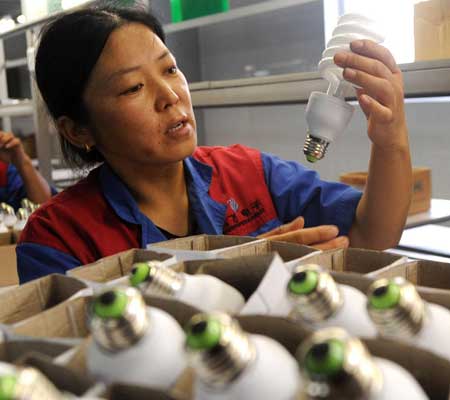
A worker examining the quality of energy-saving lamps at the production line of a private company in Henan province. Premier Wen Jiabao in May called for a cut in carbon emissions and the conservation of energy to meet the country's target set in the 11th Five-Year Plan (2006-2010) of reducing per unit gross domestic product energy consumption by 20 percent by the end of 2010 from the 2005 level. Zhao Jing / for China Daily |
SHANGHAI - The central government's relentless efforts to cut carbon emissions has seen it turn to the nation's concentrated solar thermal power (CSP) sector. However, industry experts warn the industry is still in its infancy and more investment and auxiliary policies are needed to stimulate the sector.
The industry has developed at a very fast pace to meet China's ambition to cut energy consumption, but there has not been much commercial use of CSP in the country so far, said Shi Dinghuan, director of the Chinese Renewable Energy Society.
Solar power, which involves generating electricity from the sun, is widely recognized as an effective alternative resource in the battle to reduce carbon emissions. The energy can be used directly as with photovoltaic (PV) panels, or indirectly as with CSP, with which the sun's energy is beamed through mirrors to boil water that is then used to generate electricity.
China unveiled its plans to develop CSP, which is considered to be more cost-effective than more widely-applied PV panel installations, in January, when China Shandong Penglai Electric Power Equipment Manufacturing teamed up with US-based solar thermal power maker eSolar to build a 2,000 megawatt solar thermal power installation in China within 10 years.
"PV consumes more natural resources but has a relatively lower utilization ratio of the sun than CSP. As such, the latter has more ample room for development if connected with traditional power generation technologies to realize the country's energy conservation target," said Shi, who is also the counsellor of the State Council, China's cabinet.
In May, Premier Wen Jiabao called for the cutting of carbon emissions and conservation of energy to fulfill the country's target set in the 11th Five-Year Plan (2006-2010) of reducing per unit gross domestic product (GDP) energy consumption by 20 percent by the end of 2010 from the 2005 level.
The nation in 2009 also promised to slash its carbon dioxide emissions per unit of GDP by 40 to 45 percent by 2020 from the 2005 level.
However, it may prove difficult to realize the ambition without the participation of renewable energy sources even though the Chinese government has adopted iron-handed measures to reach the target.
"Solar power has a distinct advantage when compared with other alternative energies. It will play a major role in replacing traditional energy sources in the 21st century," said Wu Dacheng, secretary-general of the Institute of PV within the China Renewable Energy Society.
The country has to consider developing CSP and PV industries from a strategic perspective, increasing investment in the research and development (R&D) of solar power-related technologies, said Xi Wenhua, director-general at the International Solar Energy Center.
|
|||||||



Industry experts called for coherent polices to allow the solar power industry, in particular the CSP sector, to undergo essential sustainable development.
"Bringing in talented people to support R&D and facilitating channels for the industry to connect with the capital market are also key for the industry," Shi said.
There are many private equity firms willing to tap into the green energy, and the government may introduce guidelines for them to do so, industry insiders said.
When the industry matures, the initial investment in CSP will gradually drop from 25,000 yuan per kilowatt in 2015 to 15,000 yuan per kilowatt by 2020. This will lure more investors into pumping capital into the industry by then, Wu said.