Comments
  Print
Print  Mail
Mail  Large Medium Small
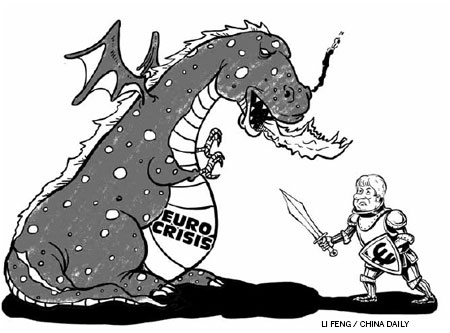
German Chancellor Angela Merkel's second visit to China in a year comes against the backdrop of dire forecasts of a difficult September for the eurozone. Mindful of such concerns and persistent pessimism in global financial markets, Merkel is now taking bold political initiatives at home and overseas. Indeed, her visit to China should be seen as an effort to assert leadership across the eurozone.
At home, Merkel recently sent out a clear message to her critics that Germany must pay a price for eurozone leadership. She cautioned her colleagues against loose talk about a "Grexit" - Greece's exit from the eurozone - and assured visiting Greek Prime Minister Antonis Samaras that Germany remained committed to his country's membership of the eurozone.
While it required courage to take such a tough stance, doing so helped to bolster her position at home and throughout the eurozone. There is now no doubt that Merkel is willing to commit Germany to the cause of preserving the European Union and the eurozone both, and that she will work to achieve that goal. If she succeeds, she will emerge as the first great European leader of the 21st century.
This stance suggests that Merkel appreciates the essence of the argument that Francois Heisbourg, chairman of the council of the International Institute for Strategic Studies, advanced in a recent essay: A federal arrangement does not fall apart because of problems at the periphery but because of "failure at the heart of the system". Merkel has come to terms with Germany's position - and that it must act to preserve the unity of the whole.
The eurozone (and probably the European Union) cannot be saved in Greece or Finland if it cannot be saved in Germany. Committing Germany to that objective is precisely what Merkel has defined as her political goal for the rest of her term in office.
Within hours of declaring her leadership at home, Merkel announced her visit to Beijing. The timing was highly significant: Merkel goes to China, the emerging global power, after declaring her own commitment to strengthening the eurozone, if not the EU as a whole, as a credible pole of an emerging multipolar world.
In recognition of Germany's growing significance, Chinese Premier Wen Jiabao welcomed a delegation of German business leaders to Beijing this May with the words: "Stronger Chinese-German cooperation is good for the two countries, good for China-EU relations, and good for world prosperity and stability. The strategic dimension of Chinese-German relations, therefore, can only be strengthened, not weakened."
There are several dimensions to the bilateral relationship. Germany needs China's markets as well as the funds that its government can use to purchase German and European bonds. It also has more than 7,500 enterprises operating in China, with gross investment totaling $18.5 billion. Moreover, Germany has sold $15 billion worth of technology to China, and bilateral trade hit a high of $169 billion in 2011, accounting for 30 percent of total China-EU trade. The two countries have set a bilateral trade target of $280 billion for 2015.
Trade, however, is not the only immediate concern. Far more important, especially for Germany, is to get China to invest in and hold its bonds. In mid-August, at the first IISS Oberoi Lecture in Mumbai, Klaus Regling, CEO of the European Financial Stability Facility, underscored the importance of Chinese demand for EFSF bonds and China's role in stabilizing the eurozone.
Regling also said there is now increased and frequent coordination between monetary authorities in the United States, Germany and China, drawing attention to the fact that the "old triad" of the dollar, euro and yen may now have been replaced by a "new triad" of the dollar, euro and renminbi. While Regling spoke of an emerging "multipolar monetary system", his remarks clearly indicated the functioning of a "tri-polar" system.
Lying at two ends of that monetary triangle, the eurozone and China have acquired a geopolitical stake in helping each other. Hans Kundnani and Jonas Parello-Plesner, of the European Council on Foreign Relations, view the China-Germany relationship as one that will shape the overall China-EU relationship. Like many strategic analysts, they also worry whether Germany, in pursuit of purely short-term economic interests, will forsake its long-term strategic interests in some political and geopolitical issues.
It is significant, therefore, that German political parties have emphasized the need for Merkel to raise such matters in her talks with Chinese leaders. However, Merkel's focus may well remain on trade, investment and currency flows. After all, unless she can turn around the eurozone, her rising profile at home and in Europe could easily wither.
What this means is that to secure German leadership of Europe, and her own leadership of Germany, Merkel has to "walk on two legs", so to speak. She needs to balance geo-economic and geopolitical factors - both interests and values - in advancing Germany's relations with China.
The author is director for geo-economic and strategy, International Institute for Strategic Studies, London. Project Syndicate
 Top 10 most valuable startups in the world
 A job to help people release pressure by chatting
 Millions spread their wings on overseas travel taking off
 Top 10 industries with the highest salary
 China's smartphone shipments decline but top five gain market share
 Railway workers to keep beddings clean during travel rush
 Top 10 most visited countries in 2015
 Girl opens special flower shop in Chengdu
 Charity event for Chinese Lunar New Year held in Vietnam
 Bad weather leaves thousands stranded at railway station
Copyright 1995 - . All rights reserved. The content (including but not limited to text, photo, multimedia information, etc) published in this site belongs to China Daily Information Co (CDIC). Without written authorization from CDIC, such content shall not be republished or used in any form. Note: Browsers with 1024*768 or higher resolution are suggested for this site.
License for publishing multimedia online 0108263 Registration Number: 20100000002731