Comments()
  Print
Print  Mail
Mail  Large Medium Small
|
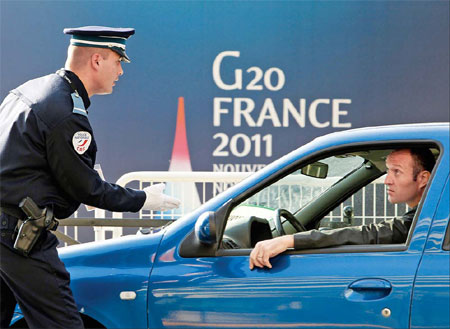
A security cordon has been thrown up around the French resort of Cannes as world leaders arrive for a critical summit amid pessimism about the global economy. [Photo /Agence France-Presse] |
President meets IMF chief ahead of critical G20 summit
CANNES, France - China wants eurozone stability, President Hu Jintao said in an interview published on Wednesday ahead of the G20 summit in the French city of Cannes.
China "sincerely wishes to see stability in the eurozone and the euro", Hu told the French newspaper Le Figaro.
The president also called on G20 leaders to "send a clear message of solidarity" and give priority to economic growth in the face of global economic challenges.
With both the US and EU burdened by heavy debt and a bleak economic outlook, China finds itself under the spotlight to help stabilize the global economy and tackle the eurozone debt crisis. But China is also cautious amid domestic pressure and an ever-changing global economy.
Chinese business officials and experts have repeatedly said that the EU needs to reform its financial institutions before the debt crisis can be tackled.
According to the Le Figaro report, Hu said G20 leaders should strive to "strengthen the coordination of macroeconomic policies (and) press ahead with the reform of the global monetary and financial system".
Hu met with Christine Lagarde, the managing director of the International Monetary Fund (IMF), on Wednesday in Cannes.
The two discussed the global economy, the reform of the international monetary system and the role of the IMF, a foreign ministry official said, without elaborating on details.
Hu's meeting with Lagarde, his first official meeting in Cannes, was interpreted by some Western observers as being solely a discussion on helping to rescue the eurozone.
Yet Chinese diplomats said its timing was purely coincidental and the meeting concentrated on China-IMF cooperation.
EU debt
The September unemployment rate in the eurozone has recorded a fifth consecutive monthly rise to reach 10.2 percent, a eurozone record. October growth figures for the EU service and manufacturing sectors experienced their largest drop in two years, with the market confidence index the lowest since 2009.
European leaders had agreed at the end of October to a $1.4 trillion rescue fund to stop the debt crisis in Greece from bleeding into other shaky eurozone economies.
The governing council of the European Central Bank will meet on Thursday to announce a fresh round of measures to help the fragile banking sector.
Yet stock markets have been rattled over the last two days by the Greek prime minister's decision to hold a referendum on the proposed bailout.
The G20 summit in Cannes, according to Thomas Klau, head of the Paris bureau of the European Council on Foreign Relations, has already, in all probability, been "transmuted into yet another eurozone crisis summit" entrusted with restoring its collective credibility.
Europe is looking to China to foot part of the rescue bill, the European Financial Stability Facility (EFSF). Yet China has legitimate concerns about getting too involved and is seeking fuller operational details. Besides, buying more eurozone debt is not on the G20 agenda.
Hu is scheduled to meet French President Nicolas Sarkozy late on Wednesday night, the first bilateral meeting Sarkozy has planned for his G20 schedule.
It has also been reported that the BRICS (Brazil, Russia, India, China and South Africa) will meet ahead of the G20 summit to agree a consensus.
Analysts said Hu's remarks convey confidence in the coming summit, as growing global economies also serve the interests of China.
Wang Yizhou, a scholar with the School of International Studies at Peking University, said China's help to the EU might not be limited to buying bonds.
It could be in the form of tariff reduction and enhancing trade, Wang said.
"Given that China is facing slowing economic growth, whatever it agrees cannot be at the expense of its own economy," said Wang Yiming, deputy director of the Institute of Macroeconomics at the National Development and Reform Commission (NDRC).
Maintaining robust growth itself has been a major contribution to the global economy, Wang said.
Economic restructuring and boosting domestic consumption is, for now, the best help that China can offer the global economy, Wang Yiming said.
Experts also said that the IMF remains a reasonable channel for China to extend its help in stabilizing the world economy.
"I don't think that China should provide money to other channels, for example, the EFSF," said TJ Bond, a senior economist at the Bank of America Merrill Lynch, who believes that China can work with the existing international financial institutions, such as the IMF, to help the European countries.
Because of the lack of details that leave critical questions unanswered, China should not hurry into the buyers list of the EFSF, said Wang Haifeng, director of the International Cooperation Center affiliated to the NDRC.
Li Xiang and Chen Jia contributed to this story.
Copyright 1995 - 2010 . All rights reserved. The content (including but not limited to text, photo, multimedia information, etc) published in this site belongs to China Daily Information Co (CDIC). Without written authorization from CDIC, such content shall not be republished or used in any form. Note: Browsers with 1024*768 or higher resolution are suggested for this site.
License for publishing multimedia online 0108263 Registration Number: 20100000002731