Although we might know better, it's still common to think of China as a monolithic whole. But it is high time to unlearn this habit and correctly perceive China's diversity.
And the most effective "New China" model of all views the vast nation through its cities, and understands China not as one big country but rather as a network of dynamic urban economies.
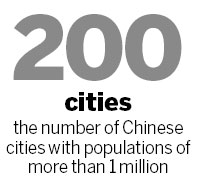
With 800-plus cities, 200 of them with populations of more than 1 million, China's metropolitan regions accounted for 78 percent of its GDP in 2010. The Western world may have reinvented the metropolis in the 20th century, but China's cities are the ones to watch in the 21st.
While Shanghai and Beijing are today's most recognized Chinese cities, numerous others are bound to become household names in the decades ahead.
Lesser-known urban centers such as Tianjin, Guangzhou, Shenzhen, Chongqing, Wuhan, Nanjing, Chengdu, Shenyang, Hangzhou, Suzhou, Foshan and Dalian are just some of the many Chinese cities that are becoming key global economic centers.
Shenzhen is expected to generate $372.7 billion and Guangzhou about $426.9 billion of total GDP growth by 2025 - greater than major world capitals such as New York, London, Los Angeles, Tokyo, Chicago and Paris.
Exactly which cities of China's massive urban galaxy will rise to prominence will be based only in part on GDP growth. Ultimately, the cities that capture the hearts and minds of the world will be the ones with the most relevant development characteristics, virtues and emotional pull. In short, the ones with the strongest urban identities.
Urban identity depends heavily on the vision and wisdom of city leaders. Building an urban identity first requires deep analysis to explore the city's DNA, connecting past to future by harnessing unique historical strengths. Singapore and Dubai, to name two successful examples, have urban identities based on deep self-knowledge and a rigorous assessment of what the world wants now and will seek in the future.
With so many cities in China having little sense of particularity of place, identity will be a major tool for shaping and building cities to effectively stand out from the crowd.
Beyond self-awareness, cities must take dramatic actions that express and strengthen that identity to assure coherence with the real urban experience. For example, Beijing is not just China's seat of government but also its cultural capital. So the decision to create a tax-free zone for the arts and entertainment industries is a logical but bold and innovative step.
In recent years of traveling around dozens of Chinese cities, we have come to greatly admire the sense of experimentation that has exploded since the launch of China's first Special Economic Zones in the 1980s.
Today one finds many Chinese cities hosting science parks for research, electric car pilot projects and other innovative industry clusters. For instance, Hangzhou will launch the world's longest bus in its rapid transit system, capable of carrying more than 300 passengers.
While many cities aspire to reduce traffic jams and emissions, the Great City being developed outside Chengdu is designed to not need any cars at all. Changsha in Hunan province is moving forward with a planned 220-story Sky City tower designed by United States-based Broad Group, as well as the eco-friendly Meixi Lake city development. Importantly, China is making it possible to visit ever more of its pulsing cities efficiently by investing massively in over 20,000 km of high-speed rail.


Copyright 1995 - . All rights reserved. The content (including but not limited to text, photo, multimedia information, etc) published in this site belongs to China Daily Information Co (CDIC). Without written authorization from CDIC, such content shall not be republished or used in any form. Note: Browsers with 1024*768 or higher resolution are suggested for this site.
License for publishing multimedia online 0108263 Registration Number: 130349