

 Comments
  Print
Print  Mail
Mail  Large Medium Small
With no hukou (urban household registration) in Beijing or other big cities, migrants cannot buy houses or register cars, nor avail themselves of medical care and education.
Dismantling the hukou system would allow farmers transplanted to cities to exchange rural property rights for a more secure foothold in the metropolis. It could also provide the boost to consumption which the Chinese leadership so craves.
In a tour to the central city of Wuhan this July, President Xi Jinping listened to reports on the progress of rural equity transactions, saying that the transfer of land must be done while respecting the will of rural residents, protecting farmland, ensuring food supplies and increasing rural residents' incomes.
Xi called for further research on the relations among the ownership, contract right and management right of rural land.
Improving farmers' share of land revenue
On the back of galloping economic growth since the start of reform in 1978, China has urbanized. The urbanization rate has increased from just under 18 percent in 1978 to over 50 percent in 2012, but if you strip away migrant workers with no hukou, the "real" rate is much lower.
Speeding up urbanization is top of the agenda to boost domestic demand in a country determined to change an aged development model still based on exports and investment.
Urbanization means modernization and land reform holds the key to urbanization, claims Hu Shuli, a renowned economic columnist, in an article on South China Morning Post. Restrictions on land development must be eased; rules for land acquisition simplified; standardized registration of ownership introduced; and full rights awarded to farmers to freely trade land on the market, she said.
While farmers cannot trade their land, the law allows the government to acquire land for public use after compensating occupants, and then legally change the land use, transferring the title to real estate developers at a substantial profit. This is currently a major source of finance for some local governments.
Compensation to farmers is often insubstantial, and bred simmering discontent and friction between farmers and local governments. Compensation for one mu of land is usually between 30,000 yuan ($4,926) and 50,000 yuan ($8210) in villages while the profits at auction could be millions of yuan.
"Local government profiteering not only threatens food security but drives farmers to protest," said Zheng Fengtian.
A lot of farmland has been requisitioned in the past decade, generating enormous earnings for local governments while leaving farmers almost excluded from the revenues. The priority is to improve the farmers' share by formalizing their rights of ownership, he said. Farmers have the right to use land but no specific tenure of ownership.
Gu Yikang, a professor at Zhejiang University, suggests farmers be given deeds of ownership. For those migrant farmers living in the cities, their ownership and management rights should be guaranteed.
Giving more money to farmers means breaking the government monopoly on land supply and reducing their earnings, so resistance from local governments is likely, said Zheng.
 Sew be it
 Latest trend in tram
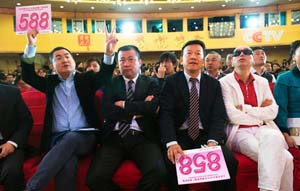 CCTV 2014 advertising auction kicks off in Beijing
 Toyota TMEC opens hybrid tech R&D operations
 Toilet paper wedding dress to advocate low carbon lifestyle
 Adrenalin-pumping competition on the course
 High-octane weekend of motorsport
 3D light show displayed in Shanghai
Copyright 1995 - . All rights reserved. The content (including but not limited to text, photo, multimedia information, etc) published in this site belongs to China Daily Information Co (CDIC). Without written authorization from CDIC, such content shall not be republished or used in any form. Note: Browsers with 1024*768 or higher resolution are suggested for this site.
License for publishing multimedia online 0108263 Registration Number: 20100000002731