Commercial sector faces slow burn


 |
|
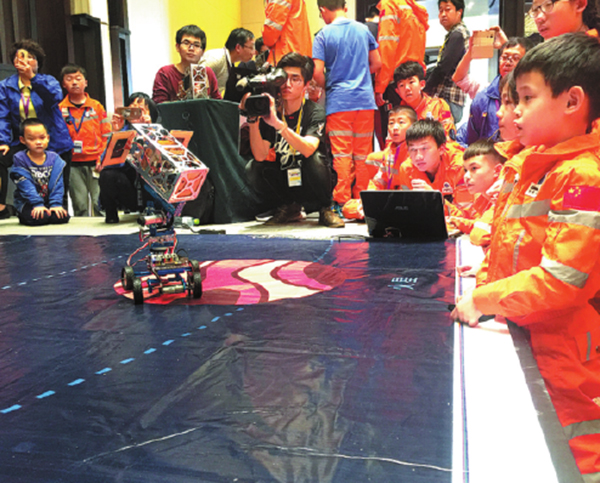
Children find out what makes a satellite tick at space startup Commsat Technology Development Co Ltd in Beijing. [Photo provided to China Daily] |
China's commercial space sector will eventually take off after a few bumpy launches.
An industry investor is confident the future is bright, but he admitted that many of the early startup businesses might not survive.
Huang He is a partner of Northern Lights Venture Capital, and the firm has already injected funding into Spacety Co Ltd. "Commercial space startups still have a long way to go to catch up with global competitors," he said.
"Quite a number of the early companies might not succeed," he added. "But they are exploring viable business models for others to follow."
As the country increases the number of commercial launches and cutting-edge technology takes over, the sector will enjoy sustainable growth.
But Huang made it clear that young Chinese entrepreneurs should start small and build up experience in the industry.
"Many startups put their focus on communication," he said. "But none of them has succeeded because it requires hundreds of microsatellites.
"Of course, that is far too expensive for them," he added. "At this early stage, they should set realistic goals and make sure they survive."
A key problem for commercial companies is the lack of launch sites. There are only a handful and they are owned by two large military conglomerates, China Aerospace Science and Technology Corp and China Aerospace Science & Industry Corp.
Commsat Technology Development Co Ltd, for instance, had to postpone its launch date for a research satellite until later this year, according to Peng Yuanyuan, the firm's co-founder and chief operating officer.
"The resource is scarce," said Yang Feng, CEO at Spacety. "So startups that can secure a launch spot enjoy a distinct advantage over others."
To solve the problem, aerospace company One Space aims to develop its first rocket, Xinshi 1, which is expected to blast off next year.
Still, there are other challenges ahead. Commercial satellite operators have to undergo a long process in accordance with China's Ministry of State Security and the United Nations' International Telecommunications Union for a designated signal frequency.
In 2015, the government rolled out favorable policies for commercial space sector companies, as well as encouraging scientific research.
"The country is also on track to open up the sector by streamlining and simplifying regulations," Peng said.