China backs Australia's cleaner iron ore project


 |
|
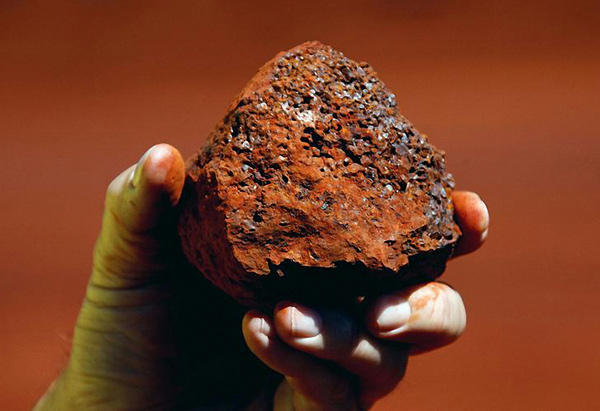
A miner holds a lump of iron ore at a mine located in the Pilbara region of Western Australia on Dec 2, 2013. [Photo / Agencies] |
Chinese engineers who carved a railway through the Qinghai-Tibet Plateau and built the world's longest sea-bridge across Hangzhou Bay have a new challenge: developing a $3.4 billion project on Australia's remote Eyre Peninsula to meet increased demand for cleaner iron ore.
China Railway Group Ltd, the world's second-largest infrastructure builder, is backing the mine, port and rail-road project that aims to supply high-quality, lower-emission ore to Chinese steel mills facing stricter environmental rules.
The project would be a major step toward South Australia's goal of securing A$10 billion ($7.7 billion) of investments to fund a stable of new iron ore mines by 2021. China Railway's partner Iron Road Ltd aims to bring the 24 million metric ton-a-year mine into production in late 2020 after tests showed its product can help customers meet the tougher standards.
Yi Zhu, an analyst at Bloomberg Intelligence in Hong Kong, said: "Chinese mainland demand for higher-quality iron ore will increase, driven by stricter environmental protection regulations and improved profitability of steel mills."
A restructuring of China's steel sector will also boost demand for premium quality imports, according to researcher CRU Group.
China plans to invest 2.5 trillion yuan ($365 billion) in renewable energy through 2020 to reduce greenhouse gases and is seeking to curb emissions by iron and steel producers. Mills are being compelled to upgrade their plants or cease operations if they fall short of standards, according to Bloomberg Intelligence.
Iron Road's iron ore will never solve all of the problems facing Chinese steel mills but "it will certainly help them," Managing Director Andrew Stocks said by phone from Adelaide.
He said: "We see an increase in productivity, a decrease in fuel use and a decrease in atmospheric emissions-it's not quite the Holy Grail, but there are three very positive attributes to improve the steel mills."
Stocks is planning to meet with banks in Beijing and Shanghai this month and expects a final investment decision to be made this year. Under an interim 12-month accord signed last year, China Railway anticipates taking as much as a 15 percent stake in the project, if approved, and will be the prime construction contractor, Iron Road said in a filing.
China Railway views the Eyre Peninsula as the preferred development location for a large-scale, long-life, high-grade iron concentrate development as opposed to competing locations in Western Australia, Eastern Canada and West Africa, according to an Iron Road filing. Calls to China Railway's Beijing office weren't answered and emails to an address on the company's website received no reply.
In 2016, China shed more than 65 million tons of excess steel capacity and 290 million tons of inefficient coal mining capacity, Premier Li Keqiang said last month.
South Australia's government believes it has the right ore to meet the new demand-about 14 billion tons of untapped magnetite, a higher-quality ore that contains more of the metal and fewer impurities than dominant market rival hematite. While it costs more to process magnetite, the product commands a premium from mills producing high-quality steel.
The state's ambition to export 50 million tons of magnetite by 2030 is dwarfed by the predominantly hematite ore production in neighboring Western Australia, which accounts for more than half of global exports and is forecast to ship more than 860 million tons this year. Magnetite currently accounts for only between 15 and 20 percent of the seaborne export market, according to researcher AME Group.
Iron ore with 62 percent content in Qingdao rose by 0.3 percent to $83.53 a dry ton on Feb 8, according to Metal Bulletin Ltd. The commodity touched a two-year high last month.
Hurdles from securing finances to displacing China's homegrown magnetite supplies also present challenges to South Australia's dream of reviving its iron ore sector. The state saw the nation's first mining of the material in the late 19th century and sent cargoes to markets including the United States, the Netherlands and Japan.
The existing market for magnetite exports is well supplied and hasn't shown major growth, though higher-quality material is likely to be required in the future, according to Fortescue Metals Group Ltd.
Bloomberg