 |
|
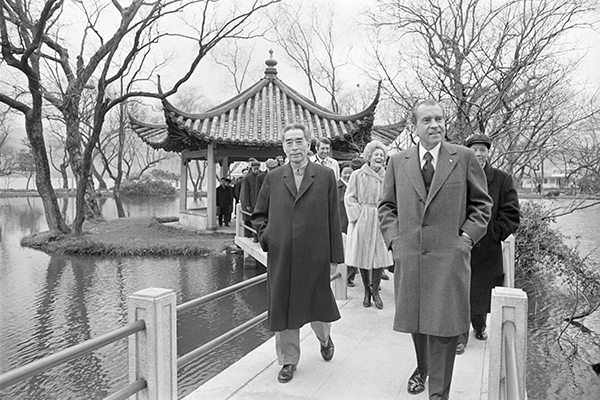
Richard Nixon (right), former US president, along with Zhou Enlai, former Chinese premier, strolls through Huagang Park on West Lake in Hangzhou on Feb 26, 1972. The Shanghai Communique was actually agreed upon in Hangzhou. [Photo?from Corbis?by Bettmann] |
Known as one of the seven capitals of ancient China, Hangzhou is gearing up to host the G20 Leaders Summit on Sunday and Monday. Though the tranquil city may not be as internationally well-known as Beijing or Shanghai, it has played a vital role, on many occasions, in forging China's diplomatic landscape.
The crucial document that ended 23 years of isolation between China and the United States, as well as resulting in the establishment of diplomatic relations between the two countries in 1979, the Shanghai Communique, which was issued on Feb 27, 1972 in Shanghai, was actually agreed upon in Hangzhou.
The negotiation for the communique continued throughout then-US president Richard Nixon's visit, which he described as "the week that changed the world", but the final version was released just a day before the US delegation headed back to Washington.
Talks over the communique in Beijing didn't go smoothly as one can easily tell from the chronology of Nixon's China visit, which showed that then-premier Zhou Enlai had meetings with Nixon for more than three hours every day after his arrival, while nothing concrete other than a schedule for activities was provided to the public.
Then, Zhou suggested changing the schedule to include Hangzhou, one of China's famous attractions.
There had been no indications prior to this that Hangzhou was to be a designated destination on the US president's agenda, but the result showed that perhaps its serene location and the lack of distractions allowed the agreement to be worked out and finalized.
On Feb 26, forsaking Air Force One, Nixon boarded Zhou's plane to travel to Hangzhou.
Despite the beautiful scenery of the World Heritage Site West Lake, the communique talks were deadlocked several times over the wording for the Taiwan question.
Beijing insisted that "China and Taiwan" or "Two Chinas" are not acceptable.
Then Vice-foreign minister Qiao Guanhua and US National Security Adviser Henry Kissinger had to work overnight to hammer out the communique in a guesthouse near the West Lake.
As dawn broke, Kissinger asked Qiao what was the name of the road that ran by the West Lake? Qiao replied it was Su Causeway, which was built by poet Su Dongpo over a thousand years ago during the Song Dynasty.
"The east side of the Su Causeway is the West Lake, right? What about the west?" Kissinger asked.
"The west part is also the West Lake," Qiao replied.
Kissinger used this example to help get over the hurdle. "Both sides of the Su Causeway are the West Lake. Then can we say the both sides of the straits are all Chinese?"
Beijing and Washington agreed with Kissinger's idea and the final wording of the Shanghai Communique read:
The United States acknowledges that all Chinese on either side of the Taiwan Strait maintain there is but one China and that Taiwan is a part of China. The United States government does not challenge that position.
Zhejiang Archives and Zhejiang Daily contributed to this story.


Copyright 1995 - . All rights reserved. The content (including but not limited to text, photo, multimedia information, etc) published in this site belongs to China Daily Information Co (CDIC). Without written authorization from CDIC, such content shall not be republished or used in any form. Note: Browsers with 1024*768 or higher resolution are suggested for this site.
License for publishing multimedia online 0108263 Registration Number: 130349