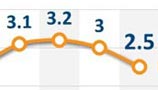
BEIJING - China's economy showed signs of stabilizing as GDP growth remained at 6.7 percent in the third quarter, although the government faces the challenges of balancing debt control and economic growth.
Official figures released on Wednesday kept China on track to meet the government's target of 6.5 to 7 percent growth for the year. The economy expanded 6.9 percent in 2015, the slowest pace in a quarter of a century.
Growth on track
"The general performance was better than expected, and the national economy grew steadily with progress being made and quality improved," said Sheng Laiyuan, spokesperson with the National Bureau of Statistics (NBS).
As external demand remains soft, the stabilization in China's economy is largely propped up by improving domestic demand, especially in the property and automobile sectors.
China's industrial output growth slowed to 6.1 percent year on year in September, down from 6.3 percent in August, as weak global demand weighed on the world's largest trader in goods.
Fixed-asset investment rose 8.2 percent in the first nine months of the year, while retail sales grew 10.7 percent year on year last month, marking a slight acceleration from August.
Private investment rebounded after a lengthy poor streak while property investment continued to accelerate in September.
As evidence that a rebalancing of China's economy from being investment-led to consumption-driven is well underway, consumption contributed to 71 percent of economic growth, up 13.3 percent year on year, while the tertiary sector grew 7.6 percent year on year in added value, the fastest among all sectors.
Meanwhile, China's producer price deflation disappeared in September for the first time since early 2012, thanks to China's efforts to cut excess capacity and promote supply-side structural reforms, especially in steel and coal, Sheng said.
The NBS said in a statement that the economy was in a critical period of transformation and upgrading, with old drivers of growth to be replaced by new ones, with many uncertain factors in the economy remaining, and that the foundations for sustained growth were not solid.
Risks under control
With GDP growth on track, the government has signaled a shift in policy focus away from stimulus and toward containing financial risks caused by easy credit.
China's new lending boomed again in September with loans to households continuing to rapidly increase, official data showed Tuesday.
This pointed to a positive sign for property and auto demand but added concerns that consumers were following the same high-leverage path as corporates.
To deleverage the economy, the government rolled out a debt-for-equity swap program in early October to bring down the corporate leverage ratio, while over a dozen Chinese cities have introduced measures to cool overheated markets, which led to marked drops in sales.
These steps gave rise to concerns whether the government could balance reducing debt with sustaining growth, as less leverage almost always means short-term slower economic activity.
The property market restrictions are timely and effective and aim to stem speculative purchases while supporting real demand, with limited impact on the economy, Sheng said.
This round of property tightening will unlikely drag down the headline growth as sharply as from 2010 onwards, as housing investment has remained lukewarm in the past few quarters despite soaring property prices, Zhou Hao, Senior EM Economist Asia with Commerzbank, said in a research note.
While a drop in housing sales will add downward pressure on the economy, we do not really foresee a risk of sharp investment slowdown, and in the coming quarter China's monetary policy will be less aggressive than estimated, Zhou added.
Expansionary fiscal policy is expected to be the major tools for the government to sustain economic growth, according to analyst estimates.
There might be continued policy support mainly in the form of infrastructure and public private partnership project approvals, said Tom Rafferty, Asia Economist with the Intelligence Unit with the Economist.


Copyright 1995 - . All rights reserved. The content (including but not limited to text, photo, multimedia information, etc) published in this site belongs to China Daily Information Co (CDIC). Without written authorization from CDIC, such content shall not be republished or used in any form. Note: Browsers with 1024*768 or higher resolution are suggested for this site.
License for publishing multimedia online 0108263 Registration Number: 130349