 |
|
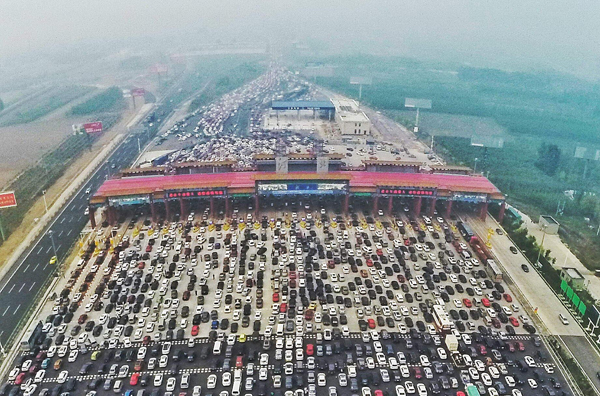
Heavy traffic at a highway toll station in Beijing last October. Local authorities are considering easing traffic problems through economic measures. Fu Ding / For China Daily |
As cars clog the country's roads, authorities are considering far tougher measures, Li Fusheng reports.
China's Ministry of Transport is urging local authorities to consider alleviating congestion through economic means such as charging congestion fees instead of relying primarily on administrative measures.
"Local governments should be cautious about curbing car sales and use, and avoid making them permanent rules. Cities that have introduced such measures should consider alternative means," said the ministry in an urban transport development program outline released on Monday.
Several major cities including Beijing, Shanghai, Tianjin and Shenzhen have been curbing car sales by demanding that people try to win license plates in a lottery or bid to buy them.
Car use is also limited in many cities from time to time, when a car is usually allowed on the road on four of five working days.
Such administrative orders have been widely criticized as simplistic and ineffective.
Experts believe the ministry's program may speed up the introduction of congestion fees in big cities like Beijing.
The capital has been the first to make public its plan to charge congestion fees. Several city officials, including Vice-Mayor Li Shixiang, admitted that the city government is considering the move, but when, how and how much to charge has not been decided.
Cui Dongshu, secretary-general of the China Passenger Car Association, sees the possible move as a symbol of progress.
"Charging a congestion fee is now the most practical solution to addressing the wrong practice of curbing car ownership but not car use in Beijing," he said.
Cui said the authorities should replace the infamous license plate lottery with fees on car usage.
"That will alleviate congestion while allowing people to own a car," he said.
Experts believe that, due to widespread traffic jams in the country, if one city introduces the fee, others will follow suit, much as they did after Beijing introduced measures to curb car purchases in 2010.
According to the Ministry of Public Security, China is home to 184 million cars, of which 135 million are privately owned, and 296 million people hold driving licenses.
The number of cities that have more than 1 million cars has reached 46, with Beijing topping the list with 5.44 million cars.
In addition to regulating private cars, the Ministry of Transport is working out a plan to improve public transport systems to ease traffic jams.
In the program, local governments are urged to ensure that in five years urban residents will have access to public transport within 500 meters of their homes and public transport will meet 75 percent of people's travel needs. Currently, 85 percent of people can find a bus stop within 500 meters of their home.


Copyright 1995 - . All rights reserved. The content (including but not limited to text, photo, multimedia information, etc) published in this site belongs to China Daily Information Co (CDIC). Without written authorization from CDIC, such content shall not be republished or used in any form. Note: Browsers with 1024*768 or higher resolution are suggested for this site.
License for publishing multimedia online 0108263 Registration Number: 130349