BEIJING - The Chinese economy is showing signs of warming as observers eagerly await the release of first-quarter GDP data next week.
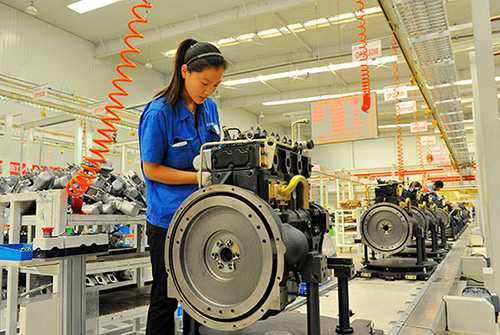
With fiscal and credit policy support beginning to take effect, the official purchasing managers' index for the manufacturing sector came in at 50.2 in March, up from February's 49 to its highest level since August. According to the data released on Friday, the index for non-manufacturing business activity stood at 53.8, up from 52.7 in February, reversing a downward trend since December.
A reading above 50 indicates expansion, while a reading below 50 represents contraction.
Meanwhile, consumer inflation in February was 2.3 percent, up from January's 1.8 percent.
The improvement came after the government took a number of pro-growth measures.
China has cut benchmark interest rates and banks' reserve requirement ratio (RRR) multiple times since 2014, and has been driven to make more such moves by the economy logging its lowest annual expansion in a quarter of a century at 6.9 percent in 2015.
In early March, the central bank announced another RRR cut of 0.5 percentage points for commercial banks, the first such cut this year.
At a press briefing last month, a central bank spokesperson described its monetary policies as "prudent with a slight easing bias."
According to the government work report unveiled last month, China is aiming for a deficit-to-GDP ratio of 3 percent for this year, up from 2.3 percent in 2015. The government deficit for 2016 is projected to be 2.18 trillion yuan ($335 billion), a rise of 560 billion yuan over last year and giving the government more money to spend.
Continued strong home sales and more efforts to destock in third- and fourth-tier cities have also helped, boosting demand for related industries in both the manufacturing and services sectors.
China's real estate investment rose 3 percent in the first two months of 2016 year on year, up from an increase of just 1 percent in the whole of 2015, official data showed.
Analysts are divided about what policy direction China could and should take from here.
"Considering that current conditions remain uncertain, the government needs to continue with moderate stimulus measures to reinforce market confidence," said Caixin chief economist He Fan.
Further monetary and fiscal policy expansion can help stabilize property investment and support urbanization-related infrastructure spending, said an HSBC report.
An economic research team with the Chinese Academy of Social Sciences also suggested that the government cut tax to reduce corporate costs and maintain an appropriate growth in money supply to reduce financing costs for the real economy.
But others expect the government to take a break from policy easing.
"Given the upcoming stabilization of real economic activity, ongoing rebound in property sales and prices, and the recent jump in headline consumer price index, we think policy easing momentum has likely peaked in the near term," said UBS chief China economist Wang Tao.
"As such, we no longer expect a benchmark interest rate cut this year," Wang said.
China is due to release the first-quarter GDP data on April 15.


Copyright 1995 - . All rights reserved. The content (including but not limited to text, photo, multimedia information, etc) published in this site belongs to China Daily Information Co (CDIC). Without written authorization from CDIC, such content shall not be republished or used in any form. Note: Browsers with 1024*768 or higher resolution are suggested for this site.
License for publishing multimedia online 0108263 Registration Number: 130349