BEIJING - Profits jumped dramatically last year for Jintong Rubber Company, a subsidiary of Yankuang Group in East China's Shandong province, only after a change in ownership.
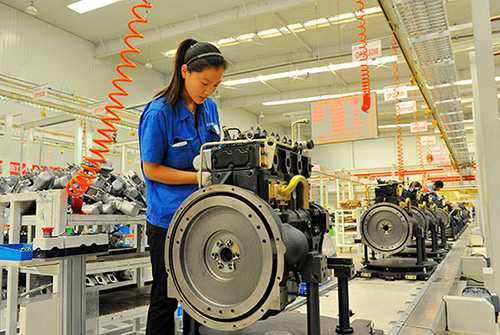
The hydraulic hose manufacturer's 19 management, technical and sales personnel purchased 45.5 percent of its capital stock in January 2015, one of the first steps in an overhaul of the structure of Yankuang, a state-owned enterprise (SOE) specialized in coal mining and machinery manufacture. After the buy-out, Jintong's profits in the first three quarters was three times the total of 2014.
"Mixed ownership binds the company with its shareholders, who, acting in their own best interests, will be more concerned about the firm's growth," said Liu Guangping, general manager of Jintong.
Mixed ownership and employee equity stakes, together with recruitment of professional executives and managers, will be coming to many SOEs this year. China is determined to deal with SOEs this year, seen as an important part of supply-side structural reform, but the success of Jintong does not mean it an easy task.
China has about 150,000 SOEs, many of which are uncompetitive with declining profits. This year, changes are planned in the powers of directors and managers; in investment, mergers and acquisitions; and in information disclosure and transparency, among others. For example, by the end of 2017, more than 80 percent of key SOEs in Tianjin should have mixed ownership and some 600 of poorest performers will exit the market.
Hebei province aims to cut the number of SOEs supervised by the province from 29 to 19 this year. Chongqing will deal with 200 zombie or shell SOEs.
Despite the wide consensus, reform remains a tough nut to crack for China's SOEs and progress is not as rapid as expected.
The desire of SOEs to carry out reform on their own is not strong compared with the zeal of the 1990s, according to Zhang Bingjun, board chairman of TEDA Investment Holding Co. Ltd in Tianjin.
The government plans to significantly relax restrictions on entry into markets such as electricity, telecommunications, petroleum and natural gas, to encourage private companies to increase investment in these areas and take ownership of some SOEs.
SOE reform is an urgent task for supply-side structural reform. It will be difficult to achieve results without transforming SOEs into real market entities in terms of technology and efficiency, said Li Yining, a Peking University economist.
Mixed ownership reform is happening in third and fourth-tier subsidiaries of SOEs, according to Li Jin, vice president of China Enterprise Reform and Development Society. Due to their huge size and heavy burdens, most SOEs at the central and provincial levels are not suitable for substantial mixed ownership for now, he said.
Private enterprises want to have a say in the running of mixed ownership firms, otherwise, they will have little interest, said the researcher. Transparency must be guaranteed, he added.

Copyright 1995 - . All rights reserved. The content (including but not limited to text, photo, multimedia information, etc) published in this site belongs to China Daily Information Co (CDIC). Without written authorization from CDIC, such content shall not be republished or used in any form. Note: Browsers with 1024*768 or higher resolution are suggested for this site.
License for publishing multimedia online 0108263 Registration Number: 130349