 |
|
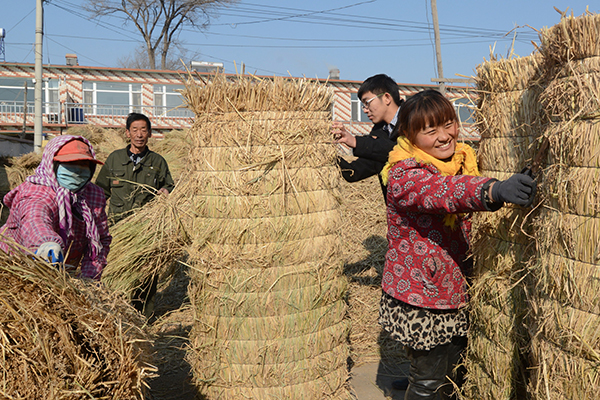
Farmers in Beizhen, Liaoning province, make mattresses out of crop stalks, instead of burning them. [Photo/China Daily] |
After the fall harvesting season last year, when many cities in northern China were enveloped in heavy smog, many sometimes pointed their fingers at farmers for polluting the urban air by burning unwanted crop stalks.
Yes, it could be part of the problem.
The government banned the random burning of crop waste and violators will be fined, but farmers played a hide-and-seek game and continued.
When I was at my home village in Henan province during Spring Festival in early February, I learned that one of my cousins was fined 2,000 yuan (about $300) when he was caught, red-handed, setting his corn stalks ablaze in the field.
He was unlucky, many fellow villagers sighed, showing sympathy for the price he paid.
With the ban in place and grassroots officials patrolling day and night for any violators after the harvest season, why do farmers still take the risk of being fined? The answer from my fellow villagers was unanimous: It's the most feasible and cost-effective way.
As the countryside modernizes, farmers are now less dependent on crop stalks for firewood or animal feed, because many have started using liquefied gas or electricity for cooking, and tractors and other machinery for farming, leaving crop stalks virtually useless.
Official statistics show that China produces 700 to 900 million metric tons of crop stalks a year, translating into more than 1 ton per capita for the rural population and posing a challenge to rural folks to properly dispose of it.
For farmers, burning is cost-efficient, and could help save labor, fertilize the soil and lower the possibility of crop pests in the coming farming season. For the government, however, it is a burning headache against the backdrop of the worsening filthy and smoggy air.
Seeing this as a big problem, the government has plans to better use crop stalks and cultivate a business out of the "valueless", in an attempt to fight pollution.
In November 2015, the National Development and Reform Commission and the ministries of finance, agriculture and environmental protection issued measures to support the comprehensive utilization of crop stalks and set an ambitious goal of bringing the utilization rate to 85 percent by 2020.
Crop stalks could be processed and used for fiber, paper pulp, biomass energy, animal feed and organic fertilizer. The government also encourages the construction of stalk collection and storage sites.
However, the cost of the use of such low-value crops is high, and without fiscal subsidies and preferential policies, paper mills and other enterprises will be less enthusiastic to expand their businesses in the sector.
And without subsidies, farmers will not bother transporting stalks to the storage sites or big cattle farms.
Another feasible way that may help prevent farmers from burning stalks is: Launching a stalk trade-in program.
When farmers hand over their agricultural waste, they could get a certain amount of fertilizer or quality seeds provided by the government. By doing so, farmers would come to realize that valueless stalks could also be valuable resources.
If well utilized, it could also help reduce imports of dry hay and alfalfa. In 2015, China imported more than 2.57 million tons of dry hay and alfalfa for animal husbandry, and the amount is still rising.
Now, it's the government's turn to act.
As I learned from my fellow villagers, they don't want to burn the unwanted crops either and have the desire to make some money out of it.
In the United States, the government has set up a fund to support the utilization of agricultural waste, mainly crop stalks, which amounts to about 900 million tons. Subsidies are provided for ethanol production using crop stalks and other clean uses.
As China embarks on the road of sustainable development and calls for the construction of a beautiful countryside, with green mountains, crystal-clear water and blue skies, the appropriate disposal and use of crop stalks have a role to play.
At the time of Spring Festival, months after the fall harvesting season, I still saw piles of corn stalks scattered in the fields near my home village. I hope such unwanted piles will disappear, and will not appear again.

Copyright 1995 - . All rights reserved. The content (including but not limited to text, photo, multimedia information, etc) published in this site belongs to China Daily Information Co (CDIC). Without written authorization from CDIC, such content shall not be republished or used in any form. Note: Browsers with 1024*768 or higher resolution are suggested for this site.
License for publishing multimedia online 0108263 Registration Number: 130349