 |
|
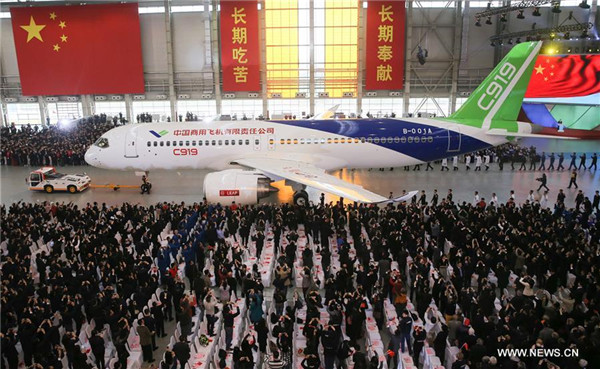
Photo taken on Nov 2, 2015 shows the C919, China's first homemade large passenger aircraft, at a plant of Commercial Aircraft Corporation of China Ltd (COMAC), in Shanghai, east China. China's economy grew by 6.9 percent in 2015. [Xinhua file photo/Pei Xin] |
By setting the GDP growth target in 2016 at a range from 6.5 to 7 percent instead of a specific figure, the Chinese government has applied more flexibility in economic management, making room for structural reform to realize long-term growth.
It is the first time China has offered an annual growth target range in two decades, and the change itself is remarkable. For the past three decades, the Chinese economy has enjoyed enviable rapid growth, and the pace of which often surpassed official GDP targets.
No countries could sustain such fast growth forever, especially for an economy as large and complicated as China's. Obsession with a high GDP growth target could delay the inevitable transition to a more sustainable model.
By setting a flexible GDP target, the central government has sent a strong signal to local officials that the figure alone is not what they should strive to seek. To steer the economy onto a more sustainable path, a more dynamic evaluation system, including environmental standards for local governments, should be established.
That does not mean the target is no longer relevant, however. The floor of 6.5 percent is a guideline for the minimum rate of growth needed in the coming five years to meet the goal of doubling GDP and per capita income from 2010 to 2020.
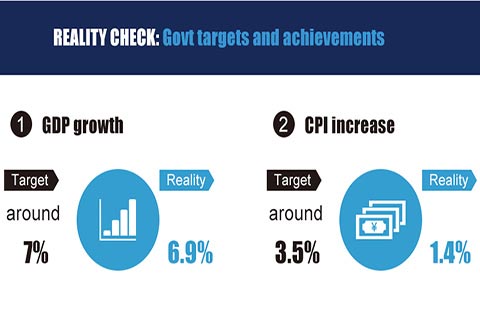
The upper guide, at 7 percent, is slightly higher than the 6.9-percent growth rate achieved in 2015, and can boost confidence if successfully met.
Achieving the minimum 6.5 percent growth should not be hard for a country with ample policy tools. Interest rates are still high compared with those in many developed countries, suggesting room for more monetary stimulus if necessary. Fiscal policies have yet to play a greater role, with the deficit ratio ready to expand.
The savings rate remains high, suggesting potential for more consumption and investment. Income levels are climbing, giving rise to an emerging middle class with growing purchase power.
With a more flexible GDP target in mind, local governments can focus more on the arduous tasks they are facing. Empty houses could pose a risk to the pillar real estate sector, while industrial restructuring could bring unemployment rarely seen since the late 1990s, when reform of the country's state-owned enterprises left many jobless.
Re-employment of workers along with structural reform will be a major task for many local officials, as the central government has repeatedly claimed keeping the employment rate stable should be a priority.
Fortunately, with a much more developed social welfare system and economic foundation, the industrial ills can be addressed with fewer pains than the 1990s.
Flexibility also means the "invisible hand" can play a bigger role in resource allocation. The government should take the opportunity to further cut red tape and unleash vitality in the private sector, while letting innovation thrive without unnecessary intervention.
The Chinese economy has come to a point where reform is a must to sustain the country's long-term prosperity. By setting a flexible GDP target, the government has taken another step forward.

Copyright 1995 - . All rights reserved. The content (including but not limited to text, photo, multimedia information, etc) published in this site belongs to China Daily Information Co (CDIC). Without written authorization from CDIC, such content shall not be republished or used in any form. Note: Browsers with 1024*768 or higher resolution are suggested for this site.
License for publishing multimedia online 0108263 Registration Number: 130349