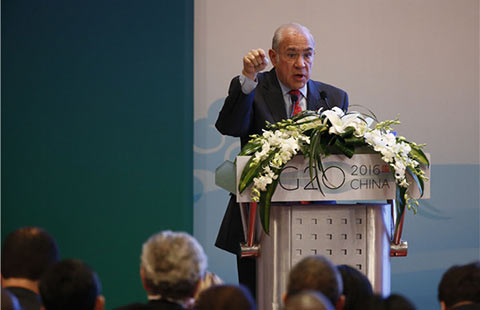
A former leading financial specialist at the World Bank said China urgently needs to develop a national strategy on inclusive finance.
Inclusive finance refers to a system that offers timely, convenient and differentiated financial services to all individuals and businesses, especially to low-income house-holds, rural residents and micro and small businesses at affordable costs.
Wang Jun, adjunct professor of finance at the China Europe International Business School, made the comments at a forum held by the Center for Microfinance Initiatives and Networks at Renmin University of China on Friday.
"Only by launching such a strategy, could we clarify a few crucial questions about inclusive finance, including what we want to achieve through its development, which people we'd like to serve, what principles we should hold to satisfy their demands, what measures to take and how to set priorities," he said.
Wang, who previously held the position of lead financial specialist for East Asia and the Pacific at the World Bank, said China needs to evaluate its current progress on inclusive finance to find out what has been achieved, what are the differences between China and other countries in this respect, and what problems still remain and why.
The country also needs to build a reliable statistical indicator system revealing the actual situation of inclusive finance.
"During the process of developing the national strategy, we should be cautious against overly politicizing inclusive finance so as not to hinder us from achieving our goals," he said.
"The government should make greater efforts in offering basic public services such as road and network infrastructure construction, rather than devoting too much attention to the direct provision of financial services and products."
The country has a severely imbalanced financial structure, according to the 2015 Green Paper of Financial Inclusion in China released by Renmin University.
Private enterprises, especially small and medium-sized ones, received only 30 percent of bank loans, although they contributed 60 percent of the country's gross domestic product and provided 80 percent of employment in cities and towns, the paper said.
"The country should strive to develop inclusive finance, as it will guide the flow of financial resources to fill a gap between financial supply and demand caused by structural imbalance."
Starting in the 1990s as small loan programs to fight poverty, the development of inclusive finance in China has accelerated since 2005, with the participation of new types of financial institutions such as small loan companies, Internet banks and peer-to-peer lending platforms.
Statistics from the China Banking Regulatory Commission showed that the balance of agriculture-related loans of China's banking institutions, excluding notes financing, rose 11.7 percent year-on-year to 26.4 trillion yuan ($4 trillion) at the end of December.
During the same period, the balance of loans for small and micro businesses reached 23.5 trillion yuan, up 13.3 percent year-on-year.

Copyright 1995 - . All rights reserved. The content (including but not limited to text, photo, multimedia information, etc) published in this site belongs to China Daily Information Co (CDIC). Without written authorization from CDIC, such content shall not be republished or used in any form. Note: Browsers with 1024*768 or higher resolution are suggested for this site.
License for publishing multimedia online 0108263 Registration Number: 130349