 |
|
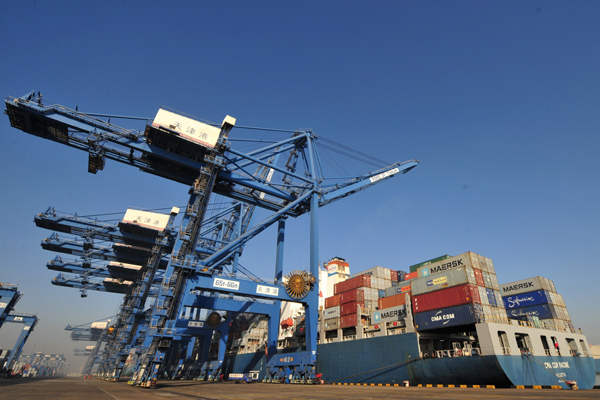
A photo of Tianjin Port. [Photo by Zhang Chenlin/Xinhua] |
As many as 20 of the 31 provinces, municipalities and autonomous regions on the Chinese mainland have either made plans or filed proposals with the central government to establish FTZs.
Liaoning, Henan and Hainan provinces and the Ningxia Hui autonomous region have officially included their concepts for local FTZs into their plans for 2016.
The chance for these provinces to get the green light from the central government seems good, development specialists and officials say. A new batch of FTZs is expected to be finalized in the first half of the year, although not all provinces will be satisfied.
The nation right now has four FTZs, all along its coastline. It established its first pilot FTZ in Shanghai in August 2013, and three more in Tianjin, Fujian and Guangdong in April.
In December, the State Council issued its "Opinions on Speeding up the Implementation of FTZ Strategy", which promised to build more FTZs.
Most likely, the new batch will give priority to inland areas that play a key role in the Belt and Road Initiative, connecting with countries across Eurasia.
Tang Wenhong, director-general of the Ministry of Commerce's Department of Foreign Investment Administration, said the new batch is also expected to increase China's competitiveness in the Asia-Pacific region.
Li Xi, Party chief of Liaoning province, said he is expecting the central government to approve the China (Dalian) Pilot Free Trade Zone quickly so that it can help the longtime industrial province reverse its rapid decline in business activity.
"The Dalian FTZ is designed not just as a copy of others but as one that is more regionally integrated, targeted and differentiated in its own functions, backed by a strong industrial foundation and strategic positioning" compared with Japan, Russia, Mongolia and the Korean Peninsula, Li said.
A free-trade zone in Dalian — an international shipping center and regional finance center in Northeast Asia — could boost trade volume between overseas markets and China's northeastern provinces and the eastern Inner Mongolia autonomous region, according to Bai Ming, a researcher at the Beijing-based Chinese Academy of International Trade and Economic Cooperation.
In particular, it could help Liaoning, which has suffered from a decline in overseas demand and rising wages, to reorient its business for the 21st century.
"For sustainable growth, local officials must pay attention to job creation," Bai said. "They should design new FTZs imaginatively so that they are more regionally integrated. They should not blindly copy existing FTZs."
At the moment, FTZs make up only a tiny part of China's economy. But they represent a future scenario for success. In the long run, economists expect the entire country's economy and economic regime to become more like today's FTZs.
In a few years, experts say, they will help China get used to a more competitive and more collaborative global business environment.
Contact the writers at zhongnan@chinadaily.com.cn

Copyright 1995 - . All rights reserved. The content (including but not limited to text, photo, multimedia information, etc) published in this site belongs to China Daily Information Co (CDIC). Without written authorization from CDIC, such content shall not be republished or used in any form. Note: Browsers with 1024*768 or higher resolution are suggested for this site.
License for publishing multimedia online 0108263 Registration Number: 130349