 |
|
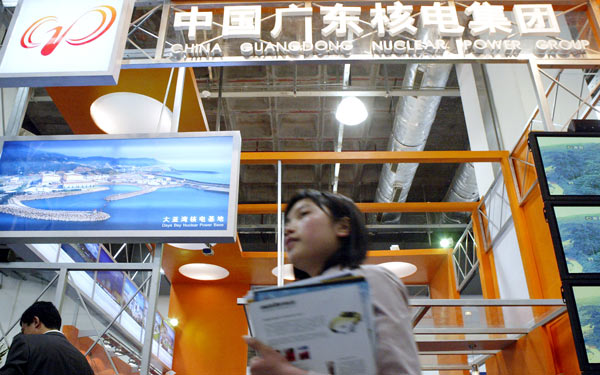
A woman passes by the China Guangdong Nuclear Power Group pavilion in a recent nuclear power equipment expo in Shanghai. [Photo/China Daily] |
Starting from May 2015, the government issued construction permits to units 5 and 6 of Fuqing nuclear power plant in southeastern Fujian province, units 3 and 4 of Fangchenggang nuclear project in Guangxi Zhuang autonomous region, and units 5 and 6 of Tianwan nuclear power plant in eastern Jiangsu province.
Experts said China's pledge to the international community that it will reduce carbon emissions and generate 20 percent of its electricity from clean energy sources by 2030, will push the country to use more nuclear power in the coming decades.
Xu said China, the world's largest energy consumer, is likely to add five or six nuclear reactors every year from 2016 to 2030, according to estimates in the draft 13th Five-Year Plan (2016-20).
"By then, nuclear power will account for 8 to 10 percent of the total energy mix," he said. Its current share is about 2 percent.
China is planning to have at least 110 nuclear reactors running by 2030. That would make it one of the largest nuclear energy users in the world.
China also aspires to be a strong nuclear player. Hence, it is seeking to develop indigenous reactor technologies. Its three nuclear power companies are working to adapt the third-generation nuclear technology to the domestic market, so as to meet future energy needs.
The first unit of Hualong One nuclear power plant already runs on homegrown third-generation technology developed jointly by China National Nuclear Corp and China General Nuclear Power Group. Some 85 percent of such reactors can be made domestically, with a design life of 60 years.
"It is clear localization will play an increasingly important role. Domestic use of indigenous technology is a prerequisite for its export," said Yu Peigen, deputy general manager of CNNC. "If the design, software and even the fuel cannot be made domestically, how could we export our technology?"
Nestor, a Chinese-built software to design nuclear reactors, was tailor-made for Hualong One, to increase efficiency and quality of the plant construction and engineering, he said.
Nestor, he said, is analogous to the iOS operating system that powers iPhones, and is key to the third-generation nuclear technology. The software is expected to give a fillip to efforts to export China's nuclear technology.
Both CGN and CNNC have their own supply chains. So, their versions of Hualong One will differ but only slightly as the reactor design is standardized, which means 28 technical features remain the same.

Copyright 1995 - . All rights reserved. The content (including but not limited to text, photo, multimedia information, etc) published in this site belongs to China Daily Information Co (CDIC). Without written authorization from CDIC, such content shall not be republished or used in any form. Note: Browsers with 1024*768 or higher resolution are suggested for this site.
License for publishing multimedia online 0108263 Registration Number: 130349