 |
|
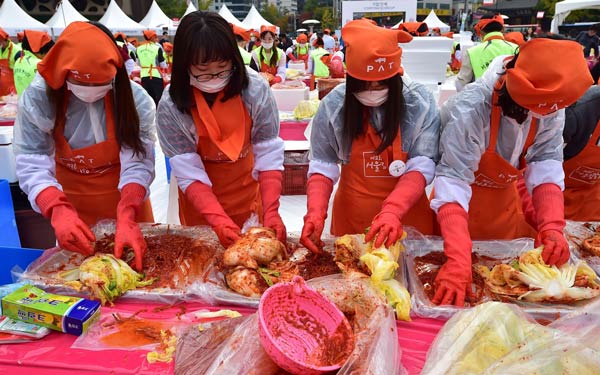
Participants take part in a kimchi making event during the Seoul Kimchi Festival outside the city hall in Seoul.[Photo/China Daily] |
With FTAs with South Korea and Australia taking effect, Chinese firms seek to switch gears to compete globally
China's free trade agreements with South Korea and Australia, which took effect last month, are expected to encourage struggling domestic manufacturers to further upgrade their technology, to return to previous levels of export growth.
It is early days still, but the FTAs will likely have profound economic implications for Chinese companies. The FTAs come at a critical time when many economies are taking decisive measures to compete with China. Countries are keen to enlarge their export volume through new technologies, modernization of their services sector, investments in Southeast Asia and effective marketing strategies.
Shin Un-cheol, chairman of the South Korea-China Marketing Association, said despite the price advantage being a core element in bilateral trade, it does not automatically mean cheaper Chinese products, like, say, pickled vegetable and garlic products, will benefit from the FTA.
"On the contrary, China's packaged food industry will face challenges," Shin said. "South Korean pickled vegetables and senate chicken soup may gain because of the FTA."
As per the China-South Korea FTA, China will remove import tariffs on 91 percent of South Korean products over the next 20 years, while Seoul will eliminate tariffs on 92 percent of Chinese goods.
South Korea's Ministry of Strategy and Finance said that China-South Korea annual trade volume is expected to reach $300 billion by the end of this year, thanks to the FTA pact.
As per the China-Australia FTA, Chinese import tariffs on 95 percent of Australian exports have been lifted, while obstacles will be removed to allow more Chinese businesses to invest Down Under. Visas will be also relaxed for Chinese visitors.
Shin said compared with South Korea's businesses related to travel, medical services, post-retirement life, films, television and entertainment, China is relatively weak and will face serious challenges.
"If these industries in China don't raise their level of service and quality, consumers will feel they are losing out," said Shin. "Already, the China-South Korea FTA has attracted the attention of Chinese film and television people. Investment of Chinese enterprises in South Korea will see explosive growth."
Dereck Ji, senior partner of Roland Berger Strategy Consultants, said Chinese manufacturers no longer can rely on low-cost material and cheap labor advantage to compete with foreign rivals.
"An open market doesn't mean lower price and low value-added products, but brands, technologies and strategic market approaches for Chinese companies. They need to put their business growth on a firmer footing," said Ji.
He said the FTAs can persuade large Chinese companies to upgrade their operations. Small and medium-sized companies could also benefit.

Copyright 1995 - . All rights reserved. The content (including but not limited to text, photo, multimedia information, etc) published in this site belongs to China Daily Information Co (CDIC). Without written authorization from CDIC, such content shall not be republished or used in any form. Note: Browsers with 1024*768 or higher resolution are suggested for this site.
License for publishing multimedia online 0108263 Registration Number: 130349