 |
|
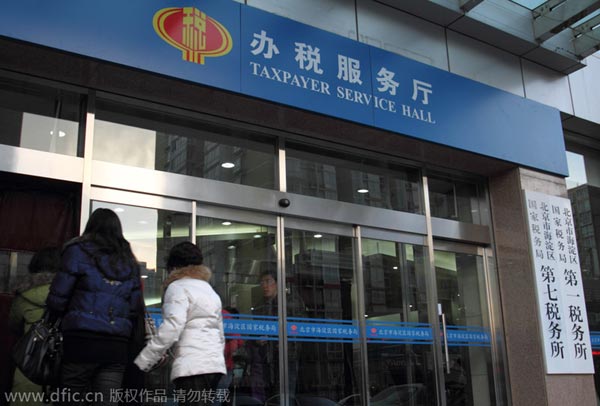
People enter a taxpayer service hall in Beijing, Dec 13, 2010. [Photo/IC] |
The State Council, China's cabinet, unveiled a plan on Thursday to reform the country's tax-collection system. The plan is expected to end the long-standing brawl between State and local tax administrations and reduce the agonies of companies, including multinationals in China.
The plan stops short of combining parallel tax collection systems into one, an idea long advocated by some experts. Instead, the divided structure will be retained, while each system's responsibilities will be further clarified and e-platform-based cooperation will be promoted.
The plan is an assurance for China's 800,000-strong tax collection army that for years has feared possible streamlining would mean massive layoffs, analysts said.
The plan works on the principle that each tax will be collected by one agency. A goal was set to build a "modern" tax collection system before 2020 so taxpayers' burdens would be alleviated and collection efficiency would be improved.
Under the current system, established in 1994, the value-added tax-a major tax imposed on industrial enterprises' products-is collected by a State agency, while business taxes imposed on companies in the service sector are collected by a local agency.
However, the ever blurring line, and the integration of products and services in a given company, make it difficult to identify how taxes should be collected. That has become a constant source of tension between the two systems.
"Two different systems may have different standards for identifying a taxable base," said Hu Yijian, a tax professor at Shanghai University of Finance and Economics. "In terms of corporate income tax, spending that can be deducted in one system might not be recognized by the other system. Corporate taxpayers often find themselves straddling the two systems and bickering."
The plan did not specify how some major taxes-such as a consumption tax split between central and local governments-would be collected but specified that administrative fees should be collected by the local agency.
Liu Shangxi, head of the Finance Ministry's Institute for Fiscal Science, said the direction is to have collection systems remain parallel but allow taxpayers to deal with just one platform.
"In the current system, taxpayers must go to different locations to pay. Certain taxes must be paid at the city or provincial level, far from the company's place of business. In the new system, they only have to go to one place, near their place of business," said Liu.
The plan proposes to allow taxpayers to pay their taxes within one province by the end of 2016, and be able to pay taxes in multiple provinces by the end 2017. A unified digital platform will be set up to allow companies to do their tax-related chores online-whether State or local.
Tax authorities will also step up scrutiny of multinationals in China. A cross-border, cross-industry monitoring system will be established by 2017 to keep multinationals' profits in check, the plan said.

Copyright 1995 - . All rights reserved. The content (including but not limited to text, photo, multimedia information, etc) published in this site belongs to China Daily Information Co (CDIC). Without written authorization from CDIC, such content shall not be republished or used in any form. Note: Browsers with 1024*768 or higher resolution are suggested for this site.
License for publishing multimedia online 0108263 Registration Number: 130349