In 2015, global headlines reflected mounting concerns about China's slowing economy and whether the country could maintain its reform momentum and complete its shift to a new growth model based on higher domestic consumption and expanded services. Although Chinese leaders are undoubtedly mindful of the growth slowdown, they remain focused on ensuring the realization of President Xi Jinping's Belt and Road Initiative. That will remain true in 2016.
China is now the world's largest trading country and the second-largest economy. But, as China's leaders know, much more needs to be done to secure what Xi has called "the great rejuvenation of the Chinese nation". To join the ranks of the world's high-income economies, China must use markets and resources, both at home and abroad, more efficiently. And it must assume more responsibility - and assert more influence - on the global stage.
The current world order undeniably favors the interests of the United States and its allies. That made sense after World War II, when the order was established. But the global balance of power has changed. If China is expected to be a "responsible stakeholder" in world affairs - and it is - it needs a more prominent role in international decision-making.
In fact, despite declarations about China's international responsibilities, the US has long seemed to be working specifically to constrain China's influence, even within its own region. That was the main motivation behind US President Barack Obama's strategic "pivot" toward Asia. Likewise, the Trans-Pacific Partnership agreement, a US-led initiative that includes a dozen Pacific Rim countries, but not China, appears aimed at sustaining America's strategic primacy and safeguarding its geopolitical and economic interests in the Asia-Pacific region.
It is up to China to secure the influence it deserves and needs. That is where Xi's Belt and Road Initiative comes in.
The idea is relatively straightforward. Inspired by the ancient Silk Road network for trade and communication, Xi's Silk Road Economic Belt and 21st Century Maritime Silk Road will link China to the rest of Asia, and Africa and ultimately Europe. By building much-needed infrastructure across the Silk Road routes, China hopes to build "a community of common interests, destiny and responsibility".
No country is better suited than China to lead the way on infrastructure. Because its own development has been propelled partly by massive investments in domestic infrastructure projects. Moreover, its huge volume of foreign exchange reserves - which stand at some $3.5 trillion and are likely to continue growing - provides the wherewithal to fund the projects.
China has already devoted some of its reserves to capitalizing the recently established Asian Infrastructure Investment Bank - an initiative that China spearheaded to support its Silk Road ambitions. The AIIB is the first initiative designed to fulfill infrastructure needs in the developing world, especially the Asia-Pacific region.
The return on these investments will be massive. Experience since WWII shows that developing countries capable of seizing the strategic opportunity of the international transfer of labor-intensive industries can achieve 20to 30 years of rapid growth. That will fuel the emergence of new markets coveted by more developed countries - including China - while creating space in China for higher-value-added industries to take hold.
As rising wages erode China's comparative advantage in labor-intensive manufacturing industries, lower-income countries, are becoming more attractive. With improved infrastructure, these countries will be better positioned to absorb the migration of China's labor-intensive industries.
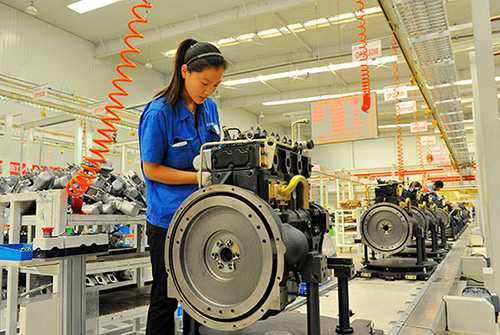
And there is a lot to absorb. In the 1960s, when Japan started to transfer its labor-intensive industries overseas, its manufacturing industry employed 9.7 million people. In the 1980s, when the four "Asian Tiger" economies (Hong Kong, Singapore, South Korea and Taiwan) underwent the same process, their manufacturing industries together employed some 5.3 million people. China's manufacturing industry, by contrast, employs 125 million workers, with 85 million in low-skill jobs. That is enough to enable virtually all of the developing economies along the new Silk Roads to achieve industrialization and modernization simultaneously.
While the world frets about China's decelerating growth and downward corrections for equity prices and the exchange rate, the country is pressing ahead with an initiative that will bring untold benefits to the entire global economy. Beyond creating unparalleled opportunities for other developing countries, the Belt and Road Initiative will enable China to make better use of domestic and international markets and resources, thereby strengthening its capacity to remain an engine of global economic growth.
The author, a former chief economist and senior vice-president at the World Bank, is professor and honorary dean of the National School of Development, Peking University. Project Syndicate

Copyright 1995 - . All rights reserved. The content (including but not limited to text, photo, multimedia information, etc) published in this site belongs to China Daily Information Co (CDIC). Without written authorization from CDIC, such content shall not be republished or used in any form. Note: Browsers with 1024*768 or higher resolution are suggested for this site.
License for publishing multimedia online 0108263 Registration Number: 130349