 |
|
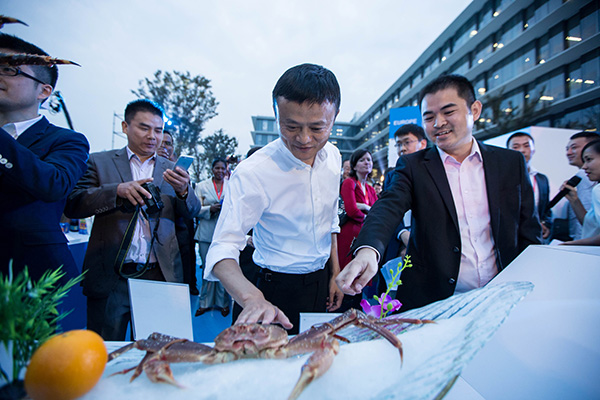
Ma Yun (center), founder and executive chairman of Alibaba Group Holding Ltd, examines an imported crab during the opening of the Tmall global food carnival, which was held in October 2015 in Hangzhou, capital of Zhejiang province. [Photo/China Daily] |
Breaking that number down, the online sector was worth 26 billion yuan ($4.09 billion) last year, which was double the 2013 figure, according to the China e-Business Research Center in Hangzhou.
By 2018, the market is projected to top more than 100 billion yuan.
There are major challenges ahead, such as upgrading the logistics industry to cope with the volume of traffic, if the business is to grow rapidly.
Cold chain storage will be another key factor, online observers point out.
Ding Chenling, an independent e-commerce analyst, underlined the issues facing companies when he compared the online grocery market to "burning cash".
"The industry excited investors between 2013 and 2014," he said. "Startups, as well as major companies, jumped into this door-to-door alternative to traditional grocery shopping.
"But we have found that it is a very difficult sector to make money, mainly because of limited cold chain logistics infrastructure in China."
Since fresh food is perishable, it is crucial that produce such as fruit, vegetables, seafood and meat are kept at the right temperature when they are transported by air, rail and road.
To stay ahead of the pack, JD.com Inc, China's second largest e-commerce player and part-owned by Tencent, improved its logistics chain.
During the summer, the company was able to deliver heat-sensitive goods, such as chocolates, with increased cold storage facilities. Naturally, this is expensive.
So far, the problems in logistics infrastructure have created a bottleneck in the online grocery sector. After all, it is not just chocolates that need to be transported at cold temperatures.
"Building and expanding such infrastructure requires a lot of money, which means the online grocery business has become a game that only rich boys such as BAT (Baidu, Alibaba and Tencent) can play," Lu Zhenwang, an independent Internet expert and chief executive officer at Wanqing Consultancy in Shanghai, said.
Others are keen to join, though, by linking up with the "big boys".
After raking in $220 million in its latest round of fundraising, Womai immediately announced it would pump $100 million into expanding its cold chain network in China during the next two years. Part of that investment came from Baidu.

Copyright 1995 - . All rights reserved. The content (including but not limited to text, photo, multimedia information, etc) published in this site belongs to China Daily Information Co (CDIC). Without written authorization from CDIC, such content shall not be republished or used in any form. Note: Browsers with 1024*768 or higher resolution are suggested for this site.
License for publishing multimedia online 0108263 Registration Number: 130349