 |
|
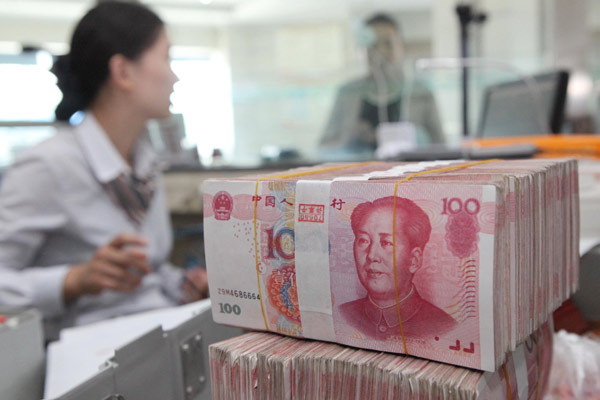
An employee counts renminbi (yuan) banknotes at a bank in Lianyungang city, East China's Jiangsu province, June 4, 2014. [Photo provided to China Daily] |
A decision by the IMF to add the currency, also known as the renminbi, to its $280 billion basket of reserves would prompt central banks to follow suit, and fund managers say they, too, would make similar adjustments to their portfolios.
"The endorsement from the IMF raises the renminbi's profile as an international reserve currency. We think many official investors will start to allocate to renminbi assets," AXA Investment Managers said in a report.
Analysts forecast the IMF would give the yuan an initial weighting of around 14 percent in the basket, which goes by the official title Special Drawing Rights (SDR), bringing about $40 billion direct inflows in the next few years.
"Most central banks we've spoken to are supportive of the inclusion and are preparing for it. Several central banks are considering their first allocation and some considering increasing their existing ones," said Jukka Pihlman, head of central banks and sovereign wealth funds at Standard Chartered.
But central bank holdings would be the tip of the iceberg.
"That will trigger a lot of FX reserve managers to rebalance," said Stephen Chang, head of Asian fixed income at J.P. Morgan Asset Management.
"Global investors are certainly under-invested in Chinese bonds as they just started from pretty much zero," he added.
Together with other reserve managers and investors, a re-allocation annually of about 1 percent of global FX reserves outside of China to yuan assets is expected in the short term. AXA estimates total inflows to be around $600 billion over the next five years.
Fund managers and analysts say the vast bulk of the flow will target fixed-income products, especially high-grade bonds issued by the Chinese government and policy banks, which offer high returns at low risk.
"We are progressively increasing our exposure to yuan bonds, and we are more interested in onshore government bonds compared to (offshore) 'dim sum' bonds," said Bryan Collins, a portfolio manager at Fidelity Worldwide Investment.
Foreign participation in China's $7 trillion onshore bond market is a meagre 2 percent at present, and Beijing is keen to broaden the sources of funding as the economy slows.
Bankers say that what the government has done to meet the technical criteria to get included in the SDR should in itself lead to an increase in foreign holdings of yuan assets.
China has scrapped quota limits for foreign central banks and sovereign wealth funds to buy bonds in its interbank market and is planning to extend yuan trading hours to cover the European trading session to attract more investors beyond Asia.
As more investors start to trade yuan bonds, improving market liquidity, that will further boost the appeal, said Sanjiv Shah, Chief Investment Officer at Sun Global Investments in London.
"It will make it easier for us to invest and will definitely lead to an increase of our investment in yuan bonds," said Shah, whose firm has assets under management of around $500 million, of which about $12 million is invested in offshore yuan bonds.

Copyright 1995 - . All rights reserved. The content (including but not limited to text, photo, multimedia information, etc) published in this site belongs to China Daily Information Co (CDIC). Without written authorization from CDIC, such content shall not be republished or used in any form. Note: Browsers with 1024*768 or higher resolution are suggested for this site.
License for publishing multimedia online 0108263 Registration Number: 130349