 |
|
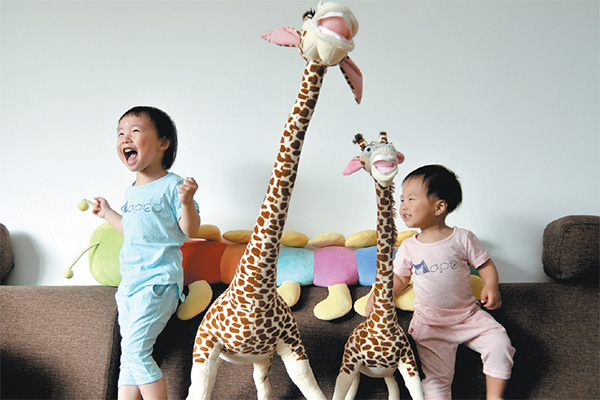
Two sisters, aged 3 and 1, are happy to get their gifts of giraffe toys on Children's Day on June 1, in Hangzhou, capital of Zhejiang province. The photographer has been tracking the children's progress over the years in this two-children family. [Photo provided to China Daily] |
Mia.com is expecting a "baby boom" windfall after the government scrapped its one-child policy last week.
The website and app specializes in infant and maternity products and has enjoyed substantial growth since it was launched in 2011.
Now, it is hoping to expand rapidly after the Fifth Plenum of the Communist Party of China decided to allow couples to have two children.
Already Mia.com is valued at $1 billion after an injection of $150 million in funding from Chinese Internet giant Baidu.com and H Capital, a venture capital firm.
"We are very positive about the baby, infant and maternity industry," Liu Nan, founder and CEO of Mia.com, said.
"Sales of daily necessities, including baby formula and diapers, will increase, while high-value products, such as baby car seats and baby food processors, are expected to be in great demand," Liu added.
Mia.com is not alone in hoping to cash in on the change of policy. Other companies in the baby-care market, as well as the auto industry, are expecting a windfall dividend. But how big this will be is open to debate.
Certainly, the impact should ease dwindling population concerns in the next 20 years and increase household consumption and growth, a report released by Goldman Sachs revealed.
"One may argue this move is too little too late, as data since the partial relaxation of the policy last year suggest many people no longer want to have children. Incentives to have more children may be needed," Song Yu, chief China economist at Goldman Sachs, said in the report. "Nevertheless, a broad-based relaxation is surely better late than never."
According to Founder Securities, revenue generated from the "baby boom" will be between 120 billion yuan ($18.95 billion) and 160 billlion yuan. Those calculations are based on the average cost of raising a child up to the age of 16, which is about 200,000 yuan.
In the short term, the food and toy industries, as well as the medical sector, will benefit.
Other key industries such as apparel will also receive a boost along with education and training establishments.
"We believe the new policy is positive to the baby-care market," Jason Yu, general manager of Kantar Worldpanel, an international consumer research company, said.
In the medium term, the two-child policy is likely to stimulate growth in the property market. Another sector that can expect to reap rewards is the auto industry.

Copyright 1995 - . All rights reserved. The content (including but not limited to text, photo, multimedia information, etc) published in this site belongs to China Daily Information Co (CDIC). Without written authorization from CDIC, such content shall not be republished or used in any form. Note: Browsers with 1024*768 or higher resolution are suggested for this site.
License for publishing multimedia online 0108263 Registration Number: 130349