 |
|
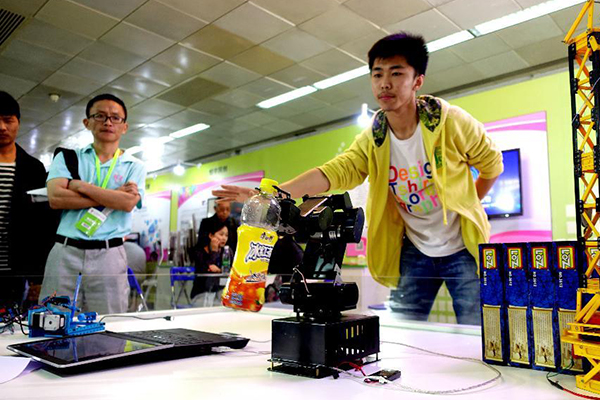
A man catches a bottle by a robot during the 18th China Beijing International High-Tech Expo in Beijing, capital of China, May 13, 2015. [Photo/Xinhua] |
A future dilemma
Since the very beginnings of robotics research, concerns such as those related in Aesop's fable The Farmer and the Snake-about a farmer who tries to save a freezing snake by placing it in his jacket, only to be fatally bitten when the animal recovers-h(huán)ave never been far from people's minds.
In December, the British scientist Stephen Hawking told the BBC that the development of full artificial intelligence could "spell the end of the human race". A month later, Microsoft's Bill Gates said humans should be worried about the threat posed by artificial intelligence.
What makes Hawking and Gates so nervous is not the sight of the endlessly repetitive robotic arms on production lines, but the dream of the founders of robotic science: the creation of a machine capable of independent sensation, thought and action.
"If we feel the wind is rising, we consider putting on a coat, and then we get a coat and put it on. In the past few decades, what we have done in robotics development has focused on giving robots the ability to grab a coat and put it on-the ability to act-but we have not given them the ability to perceive and think, which is the most difficult part," Xu Yangsheng, a member of the Chinese Academy of Engineering, told the 2015 China Conference of Artificial Intelligence, held in Beijing on July 25 and 26.
"Now is the time to be open to the idea of creating intelligence for robots," he said.
Artificial intelligence research began at a 1956 conference at Dartmouth College in the US, and early pioneers were convinced that it would only take a few decades to build a machine as intelligent as a human being.
That vision later proved to be a serious underestimation of the complexity of the task, and AI development entered a slow phase.
However, fast-paced improvements in hardware and the relatively recent development of big data-large, complex sets of data that can provide insights that lead to better, more accurate decision-making-h(huán)ave brought hope for the future of AI. Between 2009 and 2013, about $17 billion was poured into the global AI sector, which grew at more than 60 percent a year, according to a 2014 report published by the quantitative analysis company Quid.
"The development of the Internet and big data has brought a new spring for the development of AI, because big data on the Internet provides plenty of materials for AI, and thus promotes the comprehensiveness and accuracy of its learning ability," said Tan Tieniu, deputy secretary-general of the Chinese Academy of Sciences.
"However, it's still too early to say that robots are becoming smarter than humans because there's still a long way to go before we come close to developing a general-purpose AI," he said.

Copyright 1995 - . All rights reserved. The content (including but not limited to text, photo, multimedia information, etc) published in this site belongs to China Daily Information Co (CDIC). Without written authorization from CDIC, such content shall not be republished or used in any form. Note: Browsers with 1024*768 or higher resolution are suggested for this site.
License for publishing multimedia online 0108263 Registration Number: 130349