 |
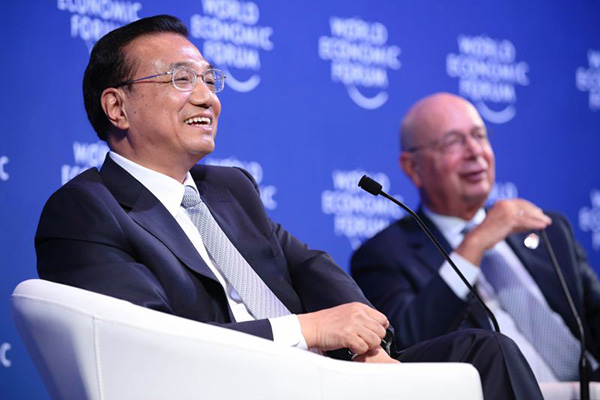
| Chinese Premier Li Keqiang speaks with global corporate leaders at the Annual Meeting of the New Champions of the World Economic Forum in Dalian, Liaoning province on September 9, 2015. [Photo provided to China Daily] |
Thank you.
Schwab: Mr. Premier, I think you gave us, as far as the economic situation is concerned, a reassuring message. But I would like to return to capital market and financial risks which have been very much on the mind of the media and the world recently.
Yorihiko Kojima, Chairman of Mitsubishi: My question is about financial risks. Our company has offices in 90 countries worldwide. China, including its stock market and debt, has attracted close global attention. What will the Chinese government do about the financial reform?This is very important for our company and customers. When will the reform measures be announced?
Li Keqiang: There have been new fluctuations on the global financial markets recently.They are a continuation of the 2008 global financial crisis. Last June and July, there were also unusual fluctuations on China's capital market. Relevant Chinese authorities took steps to stabilize the market to prevent any spread of risks. Now we can say that we have successfully forestalled potential systemic financial risks. This is not to replace or weaken the role of the market. What we did is common international practice and is in keeping with China's national conditions. Going forward, we will continue to develop a multi-tiered capital market in China and pursue a market-driven and law-based approach in this process. The purpose is to establish an open and transparent capital market of long-term, steady and healthy growth.
On China's government debt, the risks are under control. China's government debt is still at quite a low level. The central government debt is below 20 percent of GDP, and over 70 percent of local government debts take the form of investment with returns. And we are taking steps to regulate issuance of local government bonds to keep the front door open and block back doors, so to speak. Those who are concerned that China's government debt may bring serious risks are worrying too much. Having said that, I don't mean to question if there is a need for you to raise this issue, because for the Chinese, our philosophy is that one should always be mindful of potential dangers even in times of peace.
We will press ahead with the financial reform. This is critical for China's financial stability and opening-up. For example, while the central bank cut interest rates and the required reserve ratio recently, we lifted restrictions on the interest rate ceiling for fixed term deposits above one year. We will ease market access for private banks, including orderly introduction of foreign investors into the financial sector and their partnerships with Chinese counterparts. China will not waver in its commitment to pursuing the reform, nor will the reform grind to a halt.But, the reform will be conducted in a step-by-step way.
Thank you.
Richard Lesser, President and CEO of Boston Consulting Group: The Chinese renminbi devalued sharply not so long ago. Some people think that this might trigger a chain reaction, and some even worry about a currency war. What is your view on this? And also now the IMF has postponed its review of the Special Drawing Rights, how do you see the renminbi globalizing in the months and years ahead?

Copyright 1995 - . All rights reserved. The content (including but not limited to text, photo, multimedia information, etc) published in this site belongs to China Daily Information Co (CDIC). Without written authorization from CDIC, such content shall not be republished or used in any form. Note: Browsers with 1024*768 or higher resolution are suggested for this site.
License for publishing multimedia online 0108263 Registration Number: 130349