|
 |
|
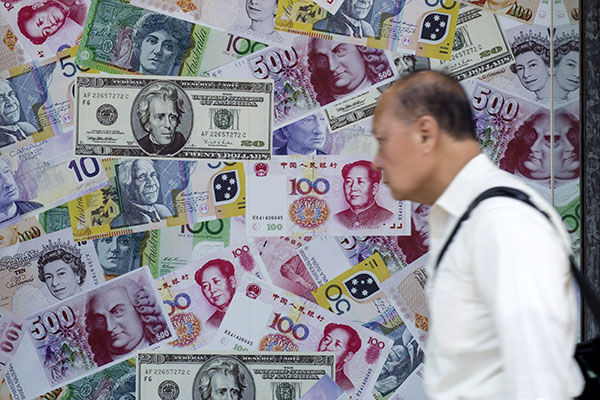
A man walks past an advertisement promoting renminbi, US dollar and euro exchange services at a foreign exchange store in Hong Kong. The daily reference rate for the Chinese currency was pegged at 6.3975 yuan per US dollar on Friday, compared with the four-year low rate of 6.4010 a day earlier. [Photo/China Daily] |
The People's Bank of China, the central bank, raised the value of the yuan against the US dollar on Friday, the first increase after a three-day depreciation of more than 4 percent.
The daily reference rate for the Chinese currency was pegged at 6.3975 yuan per dollar, compared with the four-year low rate of 6.4010 a day earlier.
The move follows comments made by Yi Gang, vice-governor of the PBOC, on Thursday that the central bank would take necessary steps to stabilize the foreign exchange market.
According to data from the PBOC, China sold about $38.8 billion of foreign exchange last month, the highest on record, suggesting huge capital outflows and more depreciation pressure on the currency. Net foreign exchange sales in June was about $15.3 billion.
Persistent weakness in the yuan can have unintended consequences, experts said, by injecting fresh uncertainties into Asian currencies, or even affect the monetary policies of major economies.
Malaysia's ringgit plunged 2.8 percent against the US dollar on Friday, the largest drop since 1998. Turkey's lira weakened 0.5 percent. An index that tracks 20 emerging currencies declined 0.2 percent.
Market consternation arose after the PBOC announced on Monday a 1.86 percent decline of the yuan-to-dollar daily fixing, the sharpest since 1994. The drop continued for three consecutive days.
The depreciation was a result of a new regime used by the PBOC to set the reference rate according to market-oriented factors, which will correct the long-term misalignment of the yuan from its market equilibrium, said experts.
Teck Leng Tan and Dominic Schnider, analysts at the Swiss financial services firm UBS AG, wrote in a research note: "Given China's size in the Asia Pacific, the recent yuan decline will have broad repercussions for other regional currencies. We reiterate our negative stance on them versus the US dollar into the Federal Reserve rate hike cycle."
Daragh Maher, an economist at HSBC Holdings Plc, also warned: "All Asian policymakers should tread carefully with their foreign exchange policies and currencies at a time when the US Federal Reserve is seen as likely to raise rates and the risks of regional market contagion are high amid heightened nervousness."
The market also expected that the European Union and Japan may sustain its quantitative easing in the coming months, as the yuan changes may lead to weak demand in global markets and further slow their economic recovery.
"The change is a critical part of China's exchange rate reforms, rather than a macro-policy easing measure per se, but the announcement has nevertheless led to fears of a 'currency war' in the region," said Maher.

Copyright 1995 - . All rights reserved. The content (including but not limited to text, photo, multimedia information, etc) published in this site belongs to China Daily Information Co (CDIC). Without written authorization from CDIC, such content shall not be republished or used in any form. Note: Browsers with 1024*768 or higher resolution are suggested for this site.
License for publishing multimedia online 0108263 Registration Number: 130349