 |
|
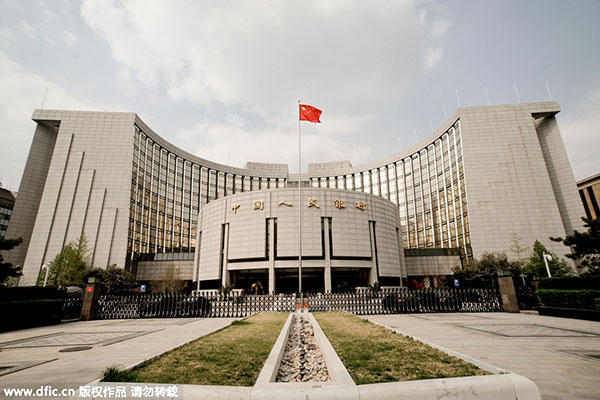
View of the headquarters and head office of the People's Bank of China (PBOC), China's central bank, in Beijing, April 3, 2015. [Photo / IC] |
Central bank may consider more easing measures to ensure adequate liquidity
The People's Bank of China, the central bank, will continue with its "prudent" monetary policy in the second half of the year, but may consider more easing measures to provide sufficient liquidity in the financial market and ensure adequate capital for government-led investment programs.
The central bank said it would adopt a more flexible approach, use various policy tools and take necessary fine-tuning steps, said a PBOC statement after a meeting attended by Governor Zhou Xiaochuan and branch heads in Beijing on Wednesday.
The main task for the ensuing months is "to maintain appropriate liquidity and achieve reasonable credit growth, and to lower borrowing costs and support key areas and vulnerable sectors", it said.
The central bank's statement follows comments made after a meeting of the Political Bureau of the Communist Party of China Central Committee on Thursday, in which President Xi Jinping stressed on the need for a prudent monetary policy to provide proper liquidity to the real economy.
Wang Tao, chief economist in China at Swiss financial services provider UBS AG, said the policy tone may involve additional rate cuts, with the next move likely toward the end of the third quarter, and proactive liquidity provisions.
"We don't see a pork-driven rebound in the Consumer Price Index as an upcoming impediment to monetary easing, as the sluggish economy in general will likely prevent any undesirable surge in inflation. Indeed, a modest degree of reflation at this stage would likely be welcomed to dispel deflationary pressures and stabilize China's debt cycle," said Wang.
It also means the possibility of an increased use of the Pledged Supplementary Lending facility to augment lending support to Public-Private-Partnership and key infrastructure projects, she said.
The PSL is a collateralized form of on-lending facility, which allows the PBOC to improve credit allocation through targeted liquidity provision. China Development Bank, the policy bank, has received the PSL since April 2014.
The PBOC announced on Monday that in July, it provided PSL of 42.9 billion yuan ($6.9 billion) to the CDB at an interest rate of 2.85 percent, lower than 3.1 percent in June. The PSL loan is to support shantytown renovation projects, said the central bank.
The central bank cut the benchmarket interest rates three times along with two cuts of the RRR in the first six months.
Qu Hongbin, chief economist in China at HSBC Holdings Plc, said that the monetary easing in conjunction with a more proactive fiscal policy will help generate a recovery in investment growth in the coming months.
He forecast an additional 25 basis points cut in the benchmark interest rates and a 200 basis points cut in the reserve requirement ratio during the second half, to strengthen the recovery in economic growth.
The growth in fixed-asset investment, which used to be the strongest engine that drove the world's second-largest economy, decelerated to a decade low of 11.4 percent year-on-year in June. Infrastructure investment grew by just 19 percent year-on-year in the first half, compared with 23 percent in the same period of last year.
The slowdown was mainly because of the high borrowing costs, which are even higher than the returns on underlying projects, said Qu.
"China's near-term growth driver will shift back toward infrastructure investment from exports and manufacturing investment."
In addition, a structural slowdown in foreign exchange inflows will push down the amount of cash that should be reserved by financial institutions, he said.
The central bank's statement also highlighted that it will keep the yuan "basically stable", as the policymakers suggested a further widening of the currency's trading band last month to support exports.
Further financial reforms will continue while greater emphasis should be put on crisis prevention and risk management, according to the statement.

Copyright 1995 - . All rights reserved. The content (including but not limited to text, photo, multimedia information, etc) published in this site belongs to China Daily Information Co (CDIC). Without written authorization from CDIC, such content shall not be republished or used in any form. Note: Browsers with 1024*768 or higher resolution are suggested for this site.
License for publishing multimedia online 0108263 Registration Number: 130349