 |
|
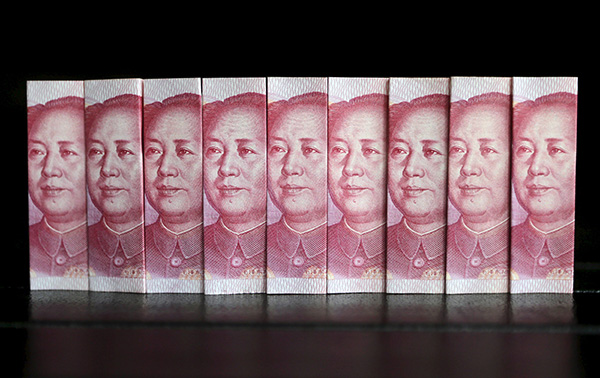
Chinese 100 yuan banknotes are seen in this file picture illustration taken in Beijing July 11, 2013. The State Council on Wednesday passed a draft amendment to China's Banking Law that gives banks more freedom to lend by removing the 75 percent loan-to-deposit ratio stipulation. [Photo/Agencies] |
BEIJING - The State Council on Wednesday passed a draft amendment to China's Banking Law that gives banks more freedom to lend by removing the 75 percent loan-to-deposit ratio stipulation.
The ratio will instead be seen as a liquidity-monitoring indicator, according to a statement released after an executive meeting chaired by Premier Li Keqiang.
The move will enable financial institutions to increase lending to agriculture, small and micro-businesses, the statement said.
The draft amendment will be tabled to the top legislature, the National People's Congress Standing Committee, for review.
China has kept the 75-percent ratio unchanged for years. Last year, the central bank expanded the definition of what constitutes a bank's deposit in a bid to release more lending capital.
The latest decision came as the government is at pains to channel credit to the real economy to support growth.
Earlier data showed China's yuan-denominated lending reached 900.8 billion yuan (147.4 billion U.S. dollars) in May, picking up from 707.9 billion yuan in April but 4.3 billion yuan less than the same period last year.
China's total social financing aggregate, a broad measure of liquidity in the economy, stood at 1.22 trillion yuan, compared with 1.05 trillion yuan a month earlier.
Minsheng Securities said the removal of the loan-to-deposit ratio may not necessarily lead to a substantial growth in credit as the ceiling is not a major constraint on growth.
The lack of financing demand, banks' reluctance to lend due to risk controls, as well as requirements on capital adequacy ratio are among the factors that have hampered credit growth, Minsheng said.
Weighed by unsteady global demand, stuttering domestic investment and a weak property sector, China's economic growth fell in the first quarter to 7 percent, its lowest level in six years.
And a string of economic indicators so far suggest growth is yet to meaningfully pick up despite a string of government-support policies, including three interest rate cuts since November.

Copyright 1995 - . All rights reserved. The content (including but not limited to text, photo, multimedia information, etc) published in this site belongs to China Daily Information Co (CDIC). Without written authorization from CDIC, such content shall not be republished or used in any form. Note: Browsers with 1024*768 or higher resolution are suggested for this site.
License for publishing multimedia online 0108263 Registration Number: 130349