 |
|
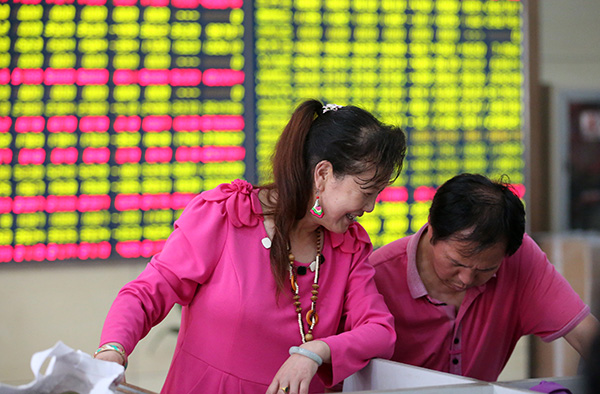
Stock investors at a brokerage in Nantong, Jiangsu province. The combination of favorable government policies on the macro level and the anticipation of improved company performance at the micro level is driving bullish sentiment. [Photo/China Daily] |
It has outperformed the Dow Jones Industrial Average, S&P500, Nasdaq and the soaring European and Japanese stock markets.
A stock market is often considered a barometer of an economy. While economic indicators remain weak in both developed and developing countries, an unusual divergence between strong equity markets and weak economic fundamentals is taking place.
The rebound of commodity price gives the market some hope, as this could mean improved global demand and a lift for emerging economies that rely on energy exports. It is also positive news for the United States economy, where concerns of deflation have emerged.
People are hoping that the recovery of the service sector could once again revive a powerful consumer market. But the fact is the desire for consumption and investment remains weak globally and earnings of most enterprises are lower than expected. So the question is what has caused the stock market boom and how long it will last.
The seemingly simple question is hard to answer. Bearish observers contend that the longer the market diverges from the economy, the greater the risk of asset bubbles. This is because people tend to invest in the equity market amid a bull run, which could depress consumption. In turn, enterprises will cut investment and turn to the capital market to hedge the risks of potential profit declines.
The vicious cycle can lead to "industrial hollowing-out". And any day, any seemingly trivial news or policy development could trigger a panic sell-off and burst the bubble.
In contrast, bulls believe that governments tend to favor the stock market, which acts as a low-cost financing channel and wealth-creation platform during economic downturns. Governments introduce monetary easing along with stimulus plans to spur industrial growth, to improve market sentiment and to address weak demand caused by insufficient bank lending.
Anticipation of government efforts to prop up the market and improved corporate performances have driven up stock prices, attracting continuous capital inflows, a situation that only pushes prices even higher.
The combination of favorable government policies on the macro level and the anticipation of improved company performance is driving bullish sentiment. Any predictions of market peaks by technical analysts have been overlooked by such optimistic investors.
Regardless of these bullish and bearish views, I think that the power of news and incidents has transcended the logic of both sides. In a market where investors find it difficult to make decisions based on companies' performance, news and incidents have become a strong force. Bears and bulls both agree on this.
Therefore, any government moves could be magnified by the market and have significant impact on the stock market. This helps explain why the US Federal Reserve has been so careful about exiting the quantitative easing.
The volatile movement of global equity markets will continue. Monetary easing will continue to prop up markets and push stock prices higher. But if government policies begin to shift, especially before "new economic fundamentals" consolidate, the stock market will very likely dive and a crisis may be triggered.
I would suggest the government accelerate market reforms including relaxation of capital controls and further opening the market to enhance investors' confidence. This will create room for market-stimulus policies to be phased out.
The longer such policies are in place, the sooner the bull market will end and a major market correction will come. That is because market hype may already reflect the anticipation of improved economic data.
The writer is the director of the Financial Research Center at Fudan University in Shanghai.

Copyright 1995 - . All rights reserved. The content (including but not limited to text, photo, multimedia information, etc) published in this site belongs to China Daily Information Co (CDIC). Without written authorization from CDIC, such content shall not be republished or used in any form. Note: Browsers with 1024*768 or higher resolution are suggested for this site.
License for publishing multimedia online 0108263 Registration Number: 130349