 |
|
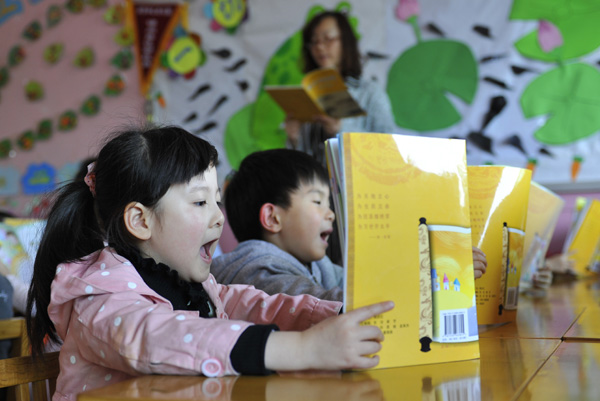
Children read the Three Character Primer, an original Chinese text for children's early education first compiled in the Song Dynasty (960-1279), at a primary school in Changzhi, Shanxi province. [Photo/China Daily] |
US high-end early education firm Kids 'R' Kids International Inc is expected to open two facilities in Beijing and Shanghai respectively this September.
The move by the company, based in the US state of Georgia, is due to the easing of China's one-child policy, which serves as a major boost to its decision to enter the Chinese market, said Lena Wang, general manager of Kids 'R' Kids China.
China's poorly developed pre-school education market, the increasing maturity of Chinese parents and their ability to judge the quality of pre-school education had propelled the introduction of its brand to China, Wang said.
"Parents born in the 1980s, unlike their predecessors, are more aware of the importance of the happiness of their child at kindergarten, instead of just the development of their academic capacities," she said.
According to a family education consumption survey conducted by this year by iResearch Consulting Group, a leading organization focusing on in-depth research of China's Internet industry, parents born after 1970 are now the majority of consumers in the children's education industry, or 63 percent, with children aged between 7 and 18 years old. About 29 percent of parents were born after 1980-the first generation of single child families, with children aged under nine. Parents who are born after 1980 are more academically advanced and have preferences in terms of online and high-tech products, according to the research.
Kids 'R' Kids plans to open 10 facilities in China over the next five years, with a mix of direct operation and chain outlets.
"Education is not an instant business," said Wang. Usually it takes two to three years before it can make a profit. A kindergarten generally involves a total investment of 5 million yuan ($806,000). Most of that money is spent on renting premises, but Wang said that more should be invested in finding the best teachers.
IResearch said that single children accounted for 91.6 percent of its interviewees and that 8.4 percent were second children. In 2013, the Chinese government allowed couples to have a second child if either of them had been a single child. From this year, the policy change could result in up to 2 million additional births every year.
Chinese parents are keen to invest in their child's education. Among families with a monthly income below 5,000 yuan, nearly half of them spend less than 300 yuan on education.
But those with a monthly income of more than 15,000 yuan spend more than 1,000 yuan a month on education. Among families with an income exceeding 30,000 yuan, more than 38 percent of them spend 2,000 yuan per month on education.
Among families with children aged under 6, around 76 percent of them purchase early education books and audio materials, 58 percent of them enroll their children in early education classes, 49 percent of them buy electronic toys for educational purposes, and 37 percent of them purchase online education applications.

Copyright 1995 - . All rights reserved. The content (including but not limited to text, photo, multimedia information, etc) published in this site belongs to China Daily Information Co (CDIC). Without written authorization from CDIC, such content shall not be republished or used in any form. Note: Browsers with 1024*768 or higher resolution are suggested for this site.
License for publishing multimedia online 0108263 Registration Number: 130349