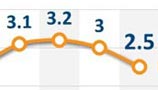
Foreign exchange reserves held by China fell by a record $79.5 billion in the first quarter of the year from the last quarter in 2014.
Official balance of payments data released by the State Administration of Foreign Exchange on Tuesday showed that the decline was more than the $29.3 billion fall in the fourth quarter of last year. Analysts and experts said this indicates a larger-than-expected capital outflow.
At the end of last year, China's total foreign exchange reserves were $3.84 trillion, compared with $3.82 trillion in 2013, and remained the world's largest.
It is the first time the SAFE has adjusted the calculation process for balance of payments in line with the International Monetary Fund standards.
Adopting global accounting norms will support the move to include the yuan in the IMF's Special Drawing Rights basket, experts said. The IMF is expected to make a decision before the end of this year.
In the first three months, the country's current account surplus increased to $78.9 billion, up from $67 billion in the fourth quarter in 2014. Deficit of the financial and capital accounts also expanded to $78.9 billion from $30.5 billion, according to a statement posted on the SAFE's website.
"Surplus in the current account and volatility of financial and capital accounts will remain in 2015 as long as there is no significant change in Chinese economic fundamentals or geopolitical circumstances," Yi Gang, deputy governor of the People's Bank of China, or the central bank, and head of the SAFE, wrote in the annual report for 2014, which was released on Monday.
Volatility of cross-border capital flows has increased since the second half of last year, although it finally achieved a net inflow of $38.2 billion, the SAFE reported.
Guo Tianyong, head of the Research Center of the Chinese Banking Industry at the Central University of Finance and Economics, said the large drop in foreign exchange reserves will have little effect as the overall total remains huge.
"But it will add pressure on the central bank's monetary policy," he said. "It means the People's Bank of China may increase money supply in other ways to offset the decrease to ensure market liquidity."
An effective way, Guo pointed out, was to further reduce the cash amount held by financial institutions or the reserve requirement ratio. Another RRR cut may be as soon as later this month, he said.
Since early February, the central bank has cut the RRR by 150 basis points, increasing liquidity by more than 1.8 trillion yuan ($289.9 billion).
Even so, media reports have speculated that the foreign exchange regulator might have sold some of the reserves to support a relatively strong yuan, which has gained 0.6 percent in the past three months.
But that has not been officially confirmed.

Copyright 1995 - . All rights reserved. The content (including but not limited to text, photo, multimedia information, etc) published in this site belongs to China Daily Information Co (CDIC). Without written authorization from CDIC, such content shall not be republished or used in any form. Note: Browsers with 1024*768 or higher resolution are suggested for this site.
License for publishing multimedia online 0108263 Registration Number: 130349